
New "Trump Accounts" for kids just launched — what grandparents should know


🔵 Most of what we cover in Quiet North is aimed at protecting what you've already built. Today's issue looks in the other direction — toward the generation coming up behind you. Over the holiday weekend, the federal government launched a new kind of savings vehicle called a "Trump Account," an investment account for children that went live alongside the country's 250th birthday. More than 6 million children have already been registered. If you have children or grandchildren, you are likely to be asked what you make of it. So let's set aside the politics and look at it the way we look at everything here: calmly, practically, and with an eye on the long run.
Key points
- New Trump Accounts give eligible children born 2025–2028 a one-time $1,000 federal deposit, invested in low-cost S&P 500 index funds.
- Families, relatives, and employers can add up to $5,000 a year; the money grows tax-deferred and becomes a traditional IRA at 18.
- Wall Street set fresh records this week — the Dow closed above 53,000 for the first time on Monday — even as AI-chip stocks turned volatile again.

Because so many readers will be weighing whether to help fund one of these for a grandchild, it's worth understanding exactly how they work before anyone writes a check.
How the accounts actually work
A Trump Account is, in plain terms, a starter retirement account for a child. The mechanics are straightforward:
- The seed money: Any U.S.-citizen child born between January 1, 2025, and December 31, 2028, is eligible for a one-time $1,000 deposit from the Treasury, once a parent opens the account.
- The contributions: Families, grandparents, friends, and even employers can add up to $5,000 per year combined. The funds are automatically invested in low-cost index funds tracking the S&P 500, with fees capped at 0.10%.
- The lock-up: The money generally can't be touched until age 18, at which point the account converts into a traditional IRA, with the usual rules that follow.
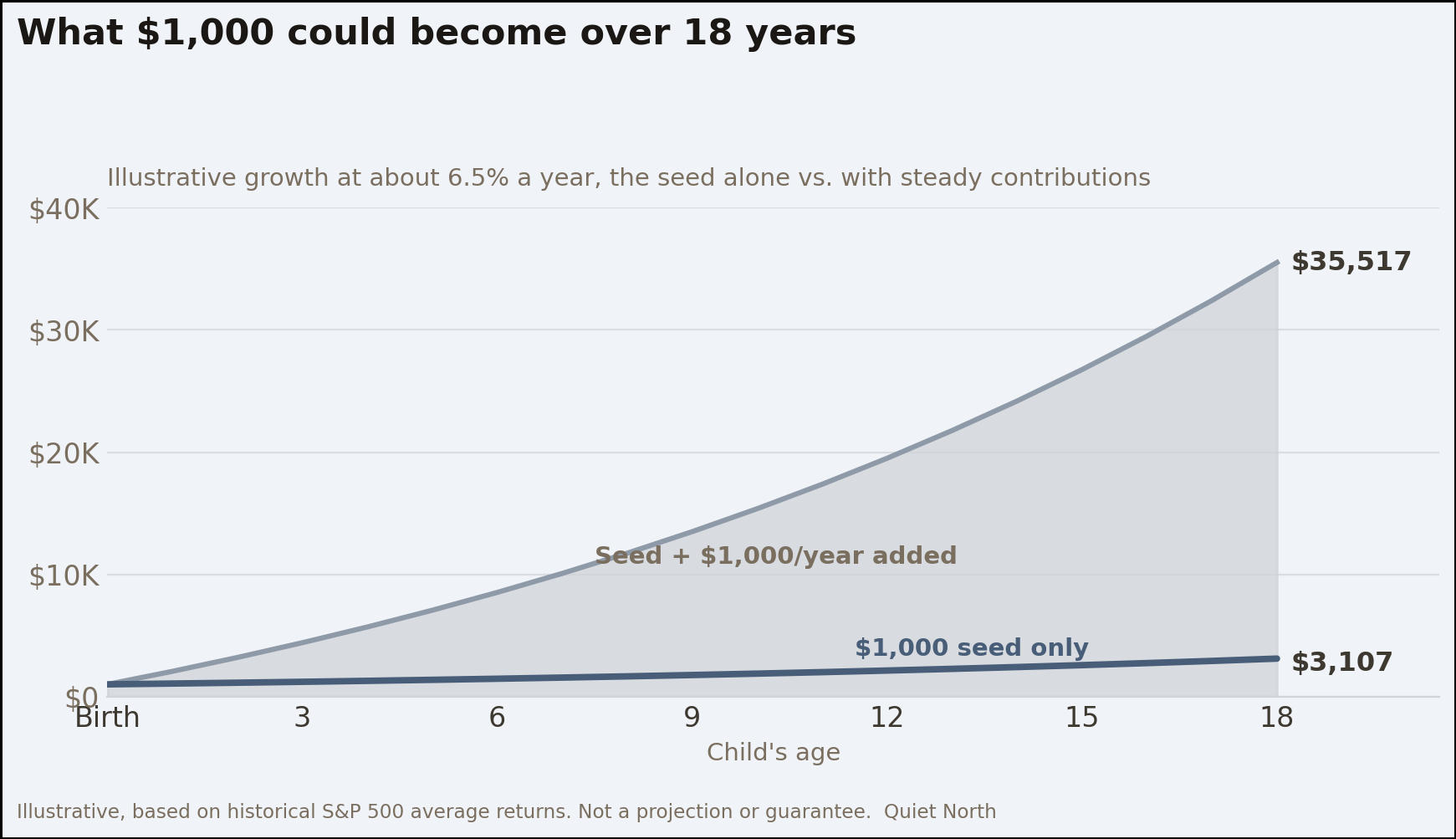
The appeal is compounding. Money invested for a newborn has nearly two decades to grow before the child can reach it — and time, not cleverness, is what does the heavy lifting in any long-term account.
That single $1,000 seed, left alone, might roughly triple by the time a child turns 18, based on historical stock-market averages. That's a pleasant head start, but not life-changing on its own. The real growth appears only when small, regular contributions are added on top — which is exactly where a grandparent's help can matter most.
Before anyone gets carried away, though, the honest caveats deserve equal time.

The fine print worth reading
No financial product is all upside, and a good decision means seeing the trade-offs clearly. A few are worth knowing:
- The child gains control at 18. Whatever has accumulated becomes theirs to manage — a five- or six-figure sum handed to a young adult. Whether that's wise depends entirely on the child.
- Withdrawals are taxed as ordinary income, and early withdrawals may face a 10% penalty, with limited exceptions for things like a first home or higher education.
- Other tools may fit better. For college specifically, a 529 plan allows far larger contributions and tax-free withdrawals for tuition. A custodial account or a Roth IRA (if the child has earned income) may suit other goals.
- The benefit favors those who can contribute. The $1,000 seed is universal, but the real growth rewards families able to add money each year — a point several economists have raised.
None of this makes the accounts good or bad. It makes them one option among several, best judged against a specific child's needs. For a grandparent, the takeaway is simple: the account can be a fine vehicle, but it's the contributions and the time, not the label on the account, that create the result.
That long-term logic — steady money, patiently invested in the broad market — is exactly what this week's headlines put on display.
A record market, and a familiar lesson
On Monday, July 6, the Dow Jones Industrial Average closed above 53,000 for the first time, finishing at 53,055. The S&P 500 and Nasdaq climbed as well. For anyone whose retirement savings — or a grandchild's new account — sits in a broad index fund, that is the compounding engine working in real time.
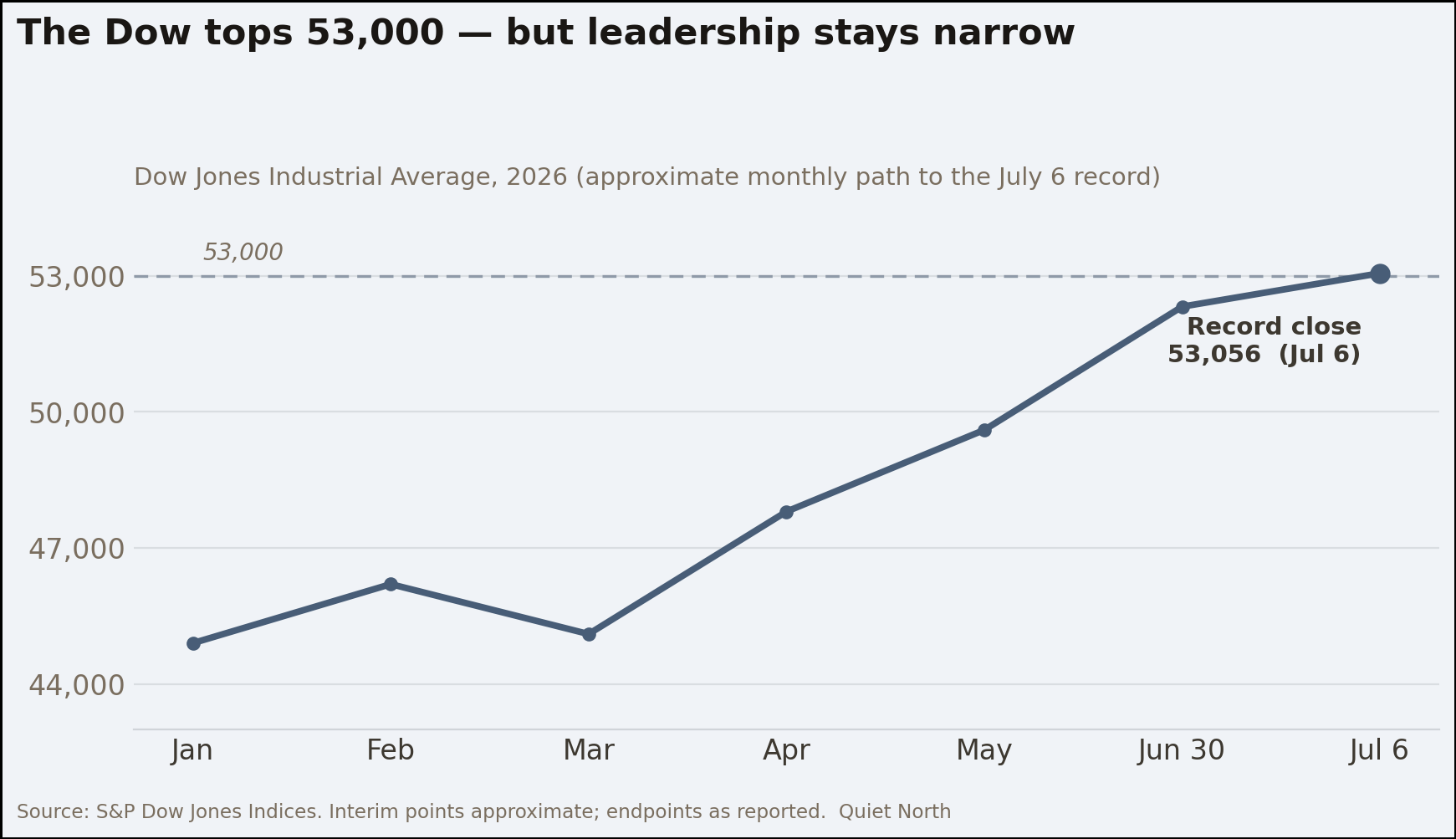
But the week also offered a reminder that the ride is never smooth. On Tuesday, chip stocks turned volatile again: Samsung, the world's largest memory-chip maker, fell nearly 9% in Seoul despite reporting a profit up nineteenfold, as investors fretted the good news wasn't good enough. It's a vivid illustration of concentration — when a handful of AI-related giants lead the market, they bring outsized market volatility with them. Elsewhere, gold held near $4,150, and the 10-year Treasury yield sat around 4.48%, keeping income options for savers reasonably attractive.
The lesson connecting all of it is the one those child accounts are built on: over 18 years, the day-to-day noise fades, and patient, diversified investing tends to win out.
🔍 What you need to know
This week's news connects the generations in a useful way:
- A new tool exists, with real strengths and real limits. The $1,000 seed is a genuine head start; the caveats around control at 18 and taxation are worth understanding.
- Compounding is the whole point. Small, early, regular contributions matter far more than the account's name or any single year's return.
- The market is at records but narrowly led. The Dow's move above 53,000 is encouraging; the AI-chip swings are a reminder that concentration cuts both ways.
- Income remains steady. With gold near $4,150 and the 10-year around 4.48%, the backdrop for savers is little changed and reasonably favorable.
❓ Today's question
"Should I open one of these accounts for my grandchild, or just add to it?"
That's a personal decision, and the right answer depends on the family's goals, so this isn't advice — only the lay of the land. Typically, the child's parent opens the account (there's a limit of one per child), and grandparents contribute to it rather than opening it themselves. Many families find the most sensible approach is to let the parent claim the $1,000 seed, then decide separately how much, if anything, to add each year and whether another vehicle like a 529 might serve a specific goal better. Because the money is locked until 18 and taxed on withdrawal, it's worth a conversation with the parents — and perhaps a tax professional — before committing. The one thing time makes clear: whatever is contributed early has the longest runway to grow.

There's something fitting about a savings account for children arriving in the same week the market set new highs and the country turned 250. All three point to the same quiet truth we return to often here: wealth, like a nation, is built slowly, through patience and small steady acts, far more than through any single grand gesture. Whatever you decide for the young people in your life, that principle is the one worth passing down. 🔔
Regards,
David Ellison
Found this information useful?