Oil jumps as the Iran ceasefire breaks — what it means for prices and rates


🔵 The calm we wrote about only a week ago proved short-lived. This morning, President Trump declared the U.S.–Iran ceasefire "over" after the two sides exchanged strikes and Iranian forces attacked oil tankers near the Strait of Hormuz. Oil, which had quietly drifted back to pre-war levels, jumped immediately: West Texas Intermediate crude rose about 6% to roughly $74.79 a barrel, with Brent close behind. For a story that can feel far away, the consequences land very close to home — at the gas pump, in the inflation data, and in the interest-rate decisions that shape income. Let's walk through what happened and, more importantly, what it means, without adding to the noise.
Key points
- The Iran ceasefire broke down overnight; oil surged roughly 6%, its sharpest move in weeks.
- Renewed inflation worries pushed the 10-year Treasury yield up toward 4.57%.
- The Federal Reserve releases the minutes of its June meeting today at 2:00 p.m. ET, its clearest signal yet on a possible rate hike.

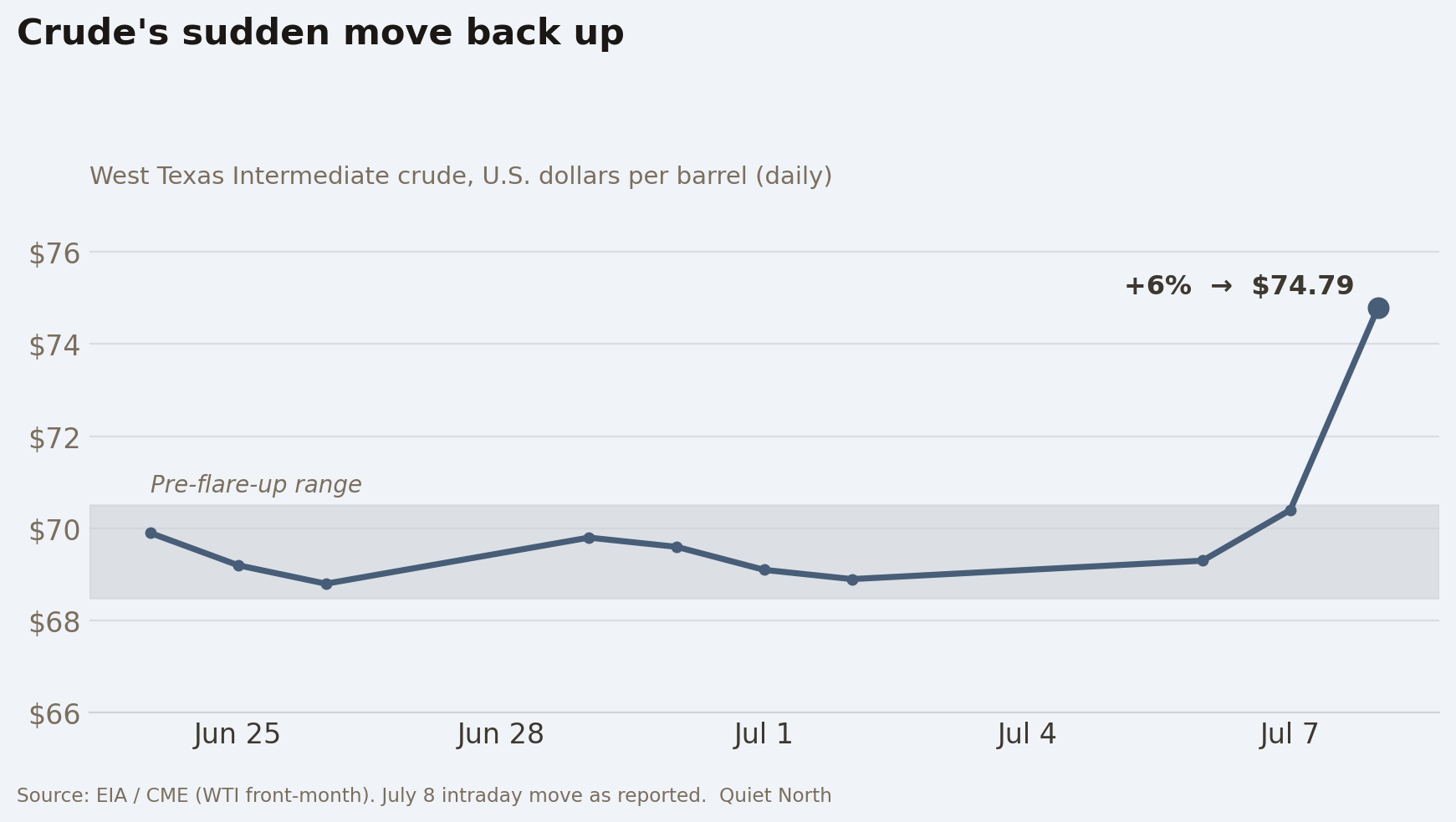
The speed of this move is the first lesson. Energy prices can reverse in a single morning, and because energy feeds into nearly everything, that reversal matters well beyond drivers.
Why a distant conflict lands at your kitchen table
The Strait of Hormuz is a narrow waterway most Americans never think about, yet roughly a fifth of the world's seaborne oil passes through it. When ships can't move safely, the price of oil rises, and the effects ripple outward with a lag:
- At the pump, gasoline had eased to a national average near $3.84 a gallon; a sustained oil spike would reverse that relief within weeks.
- In the grocery aisle and beyond, higher fuel costs raise the price of shipping, production, and nearly everything that moves by truck.
- In the inflation data, energy was the single largest driver of this spring's price increases — which is exactly why this flare-up matters to the Federal Reserve.
The U.S. has moved to revoke the license permitting Iranian oil sales, and a naval coalition raised the threat level for Strait shipping to "severe." This remains a developing, hour-by-hour situation, so it's wise to watch rather than react. But the direction is clear: the energy risk that had faded is back on the table, and with it, the risk to cost-of-living pressure.
That connection — energy to inflation to interest rates — is what makes this afternoon's Federal Reserve release unusually important.
The Fed's minutes, and why today's timing matters
At 2:00 p.m. Eastern today, the Fed publishes the minutes of its June 16–17 meeting. Ordinarily these are a quiet, backward-looking document. This time they carry more weight, for two reasons.
First, the committee was deeply divided: at that June meeting, officials split roughly nine-to-nine on whether to raise rates at all before year-end, while holding the benchmark steady at 3.50%–3.75%. Second, new Chair Kevin Warsh has deliberately said little in public, which makes the written record the clearest window into the Fed's thinking that investors will get.
Today's oil spike complicates their task. A jump in energy prices pushes inflation up, which strengthens the hand of officials who want higher rates — and markets noticed, sending the 10-year Treasury yield up toward 4.57%. For readers who depend on interest income, this cuts both ways: higher yields mean better returns on new cash yields, CDs, and Treasuries, but also pressure on bond prices and on rate-sensitive stocks like utilities. The minutes won't resolve the debate, but they will tell us how close the next decision really is.
Which brings us to an asset many people reach for at exactly moments like this — and a surprise worth understanding.
The safe haven that hasn't behaved like one
For generations, the reflex during international conflict was to reach for gold. This year has upended that assumption, and it's worth understanding why. Since the war began in late February, oil has soared while gold has actually fallen about 10%. This morning, gold held near $4,120 — steady, but hardly the dramatic surge many would expect during a shooting conflict.
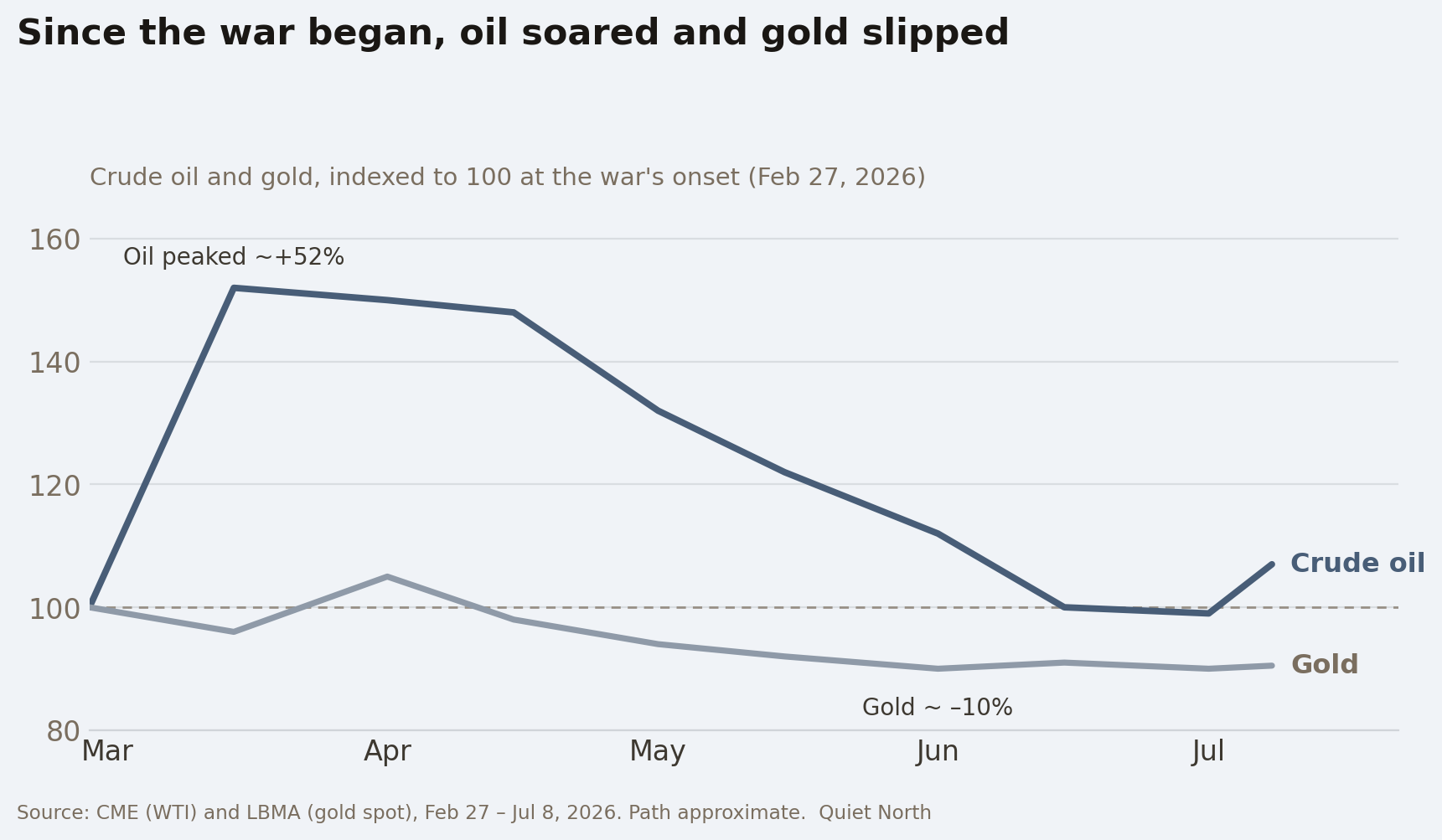
The reason is quiet but important. In 2026, gold has been driven less by fear than by real interest rates — what a Treasury bond pays after subtracting inflation. When rates are high and rising, holding gold, which pays no interest, carries a real cost. With Treasuries yielding well over 4%, that cost has weighed on the metal all year, war or no war. It's a useful reminder that gold's role is real but often misunderstood: over the long run it has served as a store of value and a hedge against currency erosion, but in any given month it may not move the way headlines suggest. Notably, the world's central banks have kept buying it steadily regardless — a vote for the long view, not the short one.
🔍 What you need to know
The energy risk has returned, but the practical response stays measured:
- Watch oil, not the war headlines. The price of crude, and whether the Strait stays disrupted, will tell you more about inflation than any single political statement.
- Higher yields are a mixed blessing. They pressure bond prices but keep income on cash and CDs attractive — a reason the current environment still favors patient savers.
- Don't mistake gold's calm for failure. Its muted response reflects high real yields, not a broken hedge; its case has always been a long-term one.
- Let the Fed minutes inform, not alarm. Today's 2:00 p.m. release will clarify how divided the Fed is — useful context, not a reason to act.
❓ Today's question
"With war flaring up again, should I expect the stock market to fall?"
Not necessarily, and history offers some reassurance here. Markets often wobble in the first hours of a geopolitical shock, then steady once the scope becomes clearer — and this conflict has already flared and calmed several times in 2026 without derailing the broader market, which closed the best quarter since 2020 just last month. Stocks dipped modestly this morning, but the larger drivers of this market remain corporate earnings and interest rates, not any single headline. That doesn't mean there's no risk; a prolonged energy shock would genuinely pressure both inflation and growth. The steadier approach is to expect some short-term market volatility, keep an eye on whether the disruption lasts, and avoid making long-term decisions on a single morning's news.

We opened last week noting how quickly calm can arrive. This week is the reminder that it can leave just as fast. Neither the calm nor the flare-up changes the fundamentals of a well-built, income-focused plan — they simply test the discipline to hold it. The headlines will be loud today. The steadier path, as always, is to understand them clearly and let the noise pass. 🔔
Regards,
David Ellison
Found this information useful?