
A briefing on the week’s reversal and what is confirmed.
A briefing on the week’s reversal and what is confirmed.


🔵 The week ends with a sharp reversal. On Wednesday, November 4, stocks surged after the midterm elections. On Thursday, November 5, they gave it all back, and more, as a selloff in artificial intelligence and chip stocks pulled the Nasdaq into a correction. This morning, Friday, November 6, a stronger-than-expected jobs report arrived, and traders raised their odds of a Federal Reserve rate increase in December.
Here is a briefing on what moved, what drove it, and what remains uncertain. Friday's figures are from premarket trading and may change by the close.
Key points
- The S&P 500 fell 4.36% on Thursday to 7,353.73, its worst day since April 2025.
- The Nasdaq fell 5.52% to 24,315.00, and CNBC reported it is now more than 10% below last month's record.
- Employers added 165,000 jobs in October, against about 65,000 expected, and unemployment fell to 4.1%, Reuters reported.
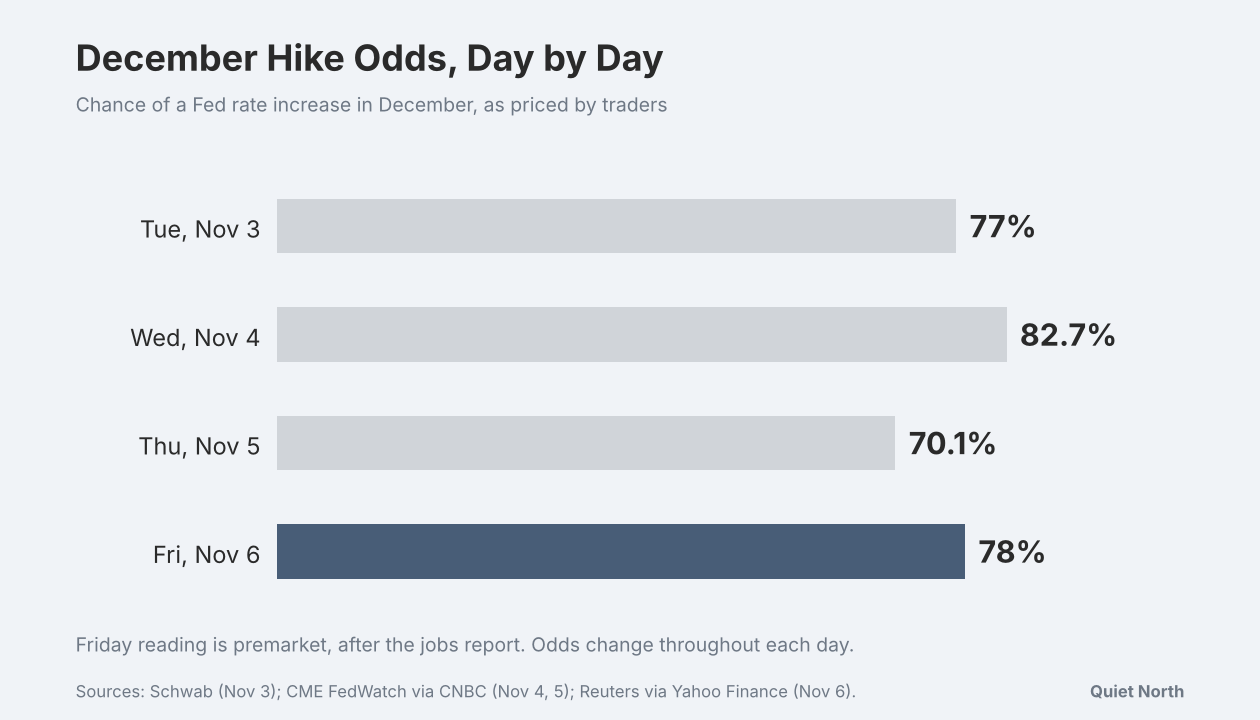
- Odds of a December Fed hike rose to 78% after the report, from 70% on Thursday, according to CME FedWatch via Reuters.
- The average 30-year mortgage rate fell to 7.18%, its third straight weekly decline, Freddie Mac reported on November 5.

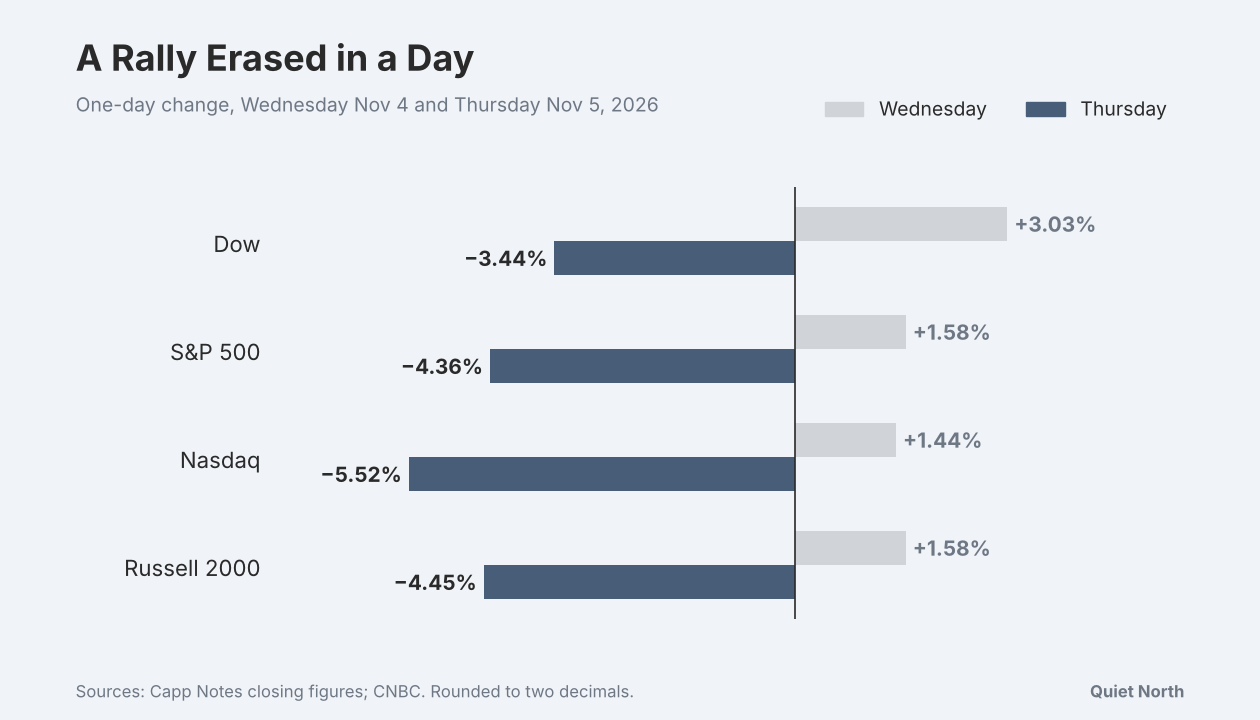
Thursday's selloff gave back Wednesday's rally
On Wednesday, the Dow rose 3.03% to 53,356.12 and the S&P 500 rose 1.58% to 7,688.62, according to Capp Notes closing figures. Thursday reversed it. The Dow fell 1,833.06 points, or 3.44%, to 51,523.06. The Russell 2000 of smaller companies fell 4.45%, and all 11 S&P 500 sectors finished lower, with technology down about 8%.
Chip stocks led the decline. According to CNBC, the iShares Semiconductor ETF fell more than 12%, its worst day since March 2020. Among the largest moves were:
- Micron: down 17.46%
- AMD: down 17.26%
- Broadcom: down 10.43%
- Nvidia: down 9.26%
The CBOE Volatility Index, a gauge of expected swings, jumped about 65% to 70% and closed in the high 20s, depending on the source. Market volatility rose from a calm reading of 16.61 on Wednesday.
What drove it: AI spending, in question again
CNBC and Reuters reported that investors feared the midterm result could slow AI spending on data centers, citing growing public opposition in some states. UBS strategists said about 30% of data-center additions expected in 2028 are now at risk, according to Reuters. Nomura's Charlie McElligott offered a second explanation: that hedge funds were locking in 2026 gains.
These are interpretations of a fast move, not settled facts, and the reasons may be debated for some time. AMD's chief executive, Lisa Su, said the market can be "a little bit short-sighted" and that demand for AI chips still looks solid. Kevin Mahn of Hennion & Walsh said "there's going to be more choppiness ahead."
Chip stocks rebounded in premarket trading this morning. Nvidia was up 4.2%, and AMD, Intel, Broadcom and Micron were each up 5% to 9%, according to Reuters. Dow futures were down about 1% at 8:43 a.m. Eastern, while Nasdaq 100 futures were up about 1.3%, so Friday's opening is uncertain.
By our calculation from closing levels, the S&P 500 is down about 3.0% for the week through Thursday, and the Nasdaq about 4.4%. Reuters said the S&P 500 was on pace for its worst week since March 2025.
The jobs report kept the Fed in play
The Labor Department's October report showed payrolls rose by 165,000, well above the 65,000 forecast in a Reuters poll. September's gain was revised up to 60,000 from 29,000, and the unemployment rate slipped to 4.1% from 4.2%. Weekly jobless claims on Thursday were 189,000, the lowest since late July.
Average hourly earnings rose 3.1% from a year earlier. With inflation higher than that, one economist noted that real wages declined. That is the cost-of-living pressure on paychecks that we have followed in recent weeks.
Treasury yields rose after the report and then eased. The 2-year was about 4.52%, the 10-year about 4.88% and the 30-year about 5.29%. Traders now put the chance of a December increase at 78%, according to Reuters. It was near 83% on Wednesday and 70% on Thursday, so the odds have moved by double digits within three days.
Oil, gold and mortgage rates
Oil ended the week sharply lower despite a bounce on Thursday. WTI settled at $90.52 on Thursday, up 2.7%, but it as $104.12 a week earlier, a drop of about 13% by our calculation. Brent was near $97.56 early this morning, per TipRanks. Reuters said the S&P 500 energy index was on track for a weekly decline of more than 11%. Energy costs have eased at the margin, but Iran-related news still moves oil by the hour.
Gold briefly reached $4,134.83 on Thursday, and spot gold was about $4,044 early Friday, down 1.1%, according to FinanceFeeds. Reuters said it is on track for its best week since late August. The Friday dip reflects investors selling gold to cover stock losses and a firmer dollar. Gold's role as a safe haven did not show up cleanly on one day, but showed over the week.
Freddie Mac reported the average 30-year mortgage at 7.18% on November 5, from 7.24%, with the 15-year at 6.57%. A year ago the 30-year rate was 6.22%.
🔍 What This Means For You
- One day can undo a week of gains. Thursday's drop erased Wednesday's rally in every major index.
- Index declines are not evenly shared. Chips fell 10% to 17%, while the Dow fell 3.44%.
- Strong jobs data can keep rates high. December hike odds are 78%.
- Wages are lagging inflation. Earnings rose 3.1% while inflation is higher.
- Mortgage rates have dipped for three weeks. The average is 7.18%, still above last year.
❓ Today's question
"What is a stock market 'correction,' and is the Nasdaq in a bear market?"
A correction is usually defined as a decline of 10% or more from a recent high. A bear market is a decline of 20% or more. CNBC reported that the Nasdaq Composite is now more than 10% below its record from last month, which puts it in a correction but not a bear market. Corrections are fairly common, and some end quickly while others deepen. Nobody can say in advance which one this will be.

A week like this one is a reminder that headlines move faster than the underlying numbers. The facts above, such as closing levels and the jobs report, are settled, and the explanations for them are still being debated.
Markets will reopen Monday with new information. Until then, separating what is confirmed from what is projected is a steadier way to read the news. 🔔
Regards,
David Ellison
Found this information useful?