
Good news, high prices: what Tuesday’s data really said (Copy)


🔵 The Federal Reserve left interest rates unchanged on Wednesday, October 28, and the first hard data since then arrived this morning, Thursday, October 29. Growth came in stronger than expected, inflation remained high, and Alphabet's results gave investors a fresh reason to question how much artificial intelligence spending will pay off. Stocks were mixed in morning trading, with large technology shares lower and smaller companies higher.
Here is a briefing on what the Fed decided, what the new numbers show, and what is still unsettled. Some figures below are from morning trading and may change by the close.
Key points
- The Fed held its rate at 3.75% to 4.00% on a 10-2 vote. Two officials wanted a quarter-point increase.
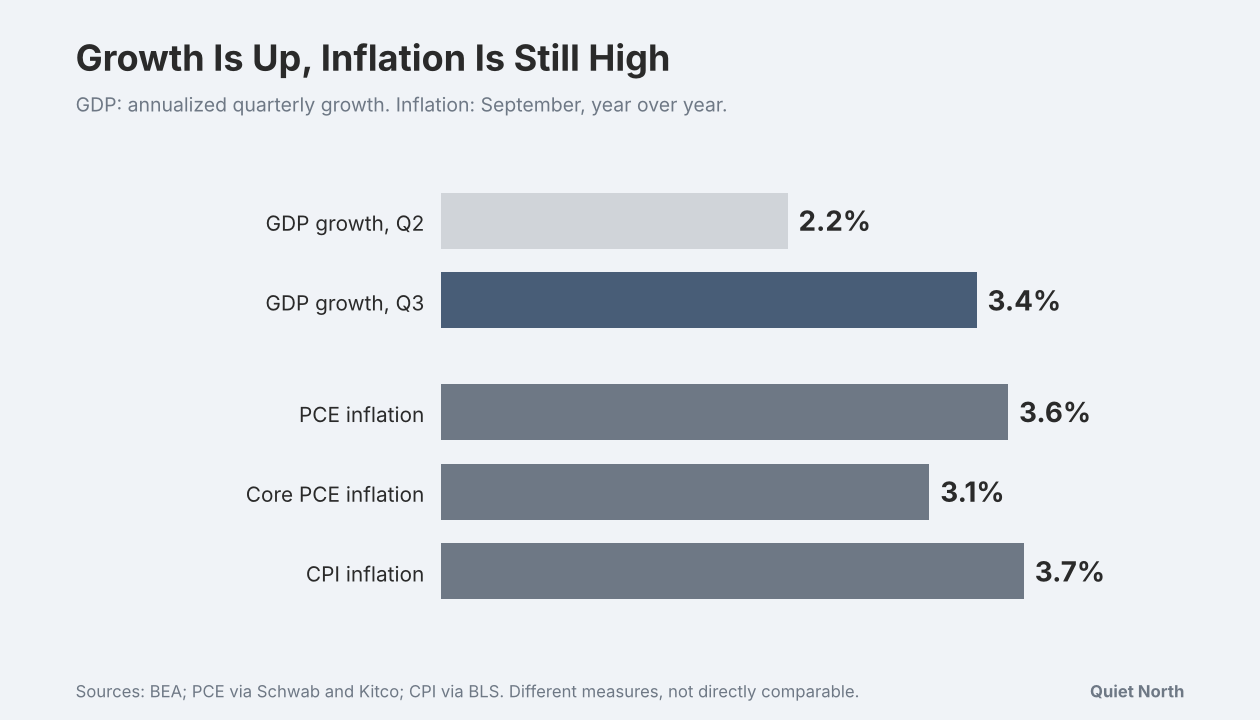
- September inflation by the Fed's preferred gauge was 3.6% over the past year, with core at 3.1%.
- Third-quarter GDP grew at a 3.4% annual rate, up from 2.2% in the second quarter, according to the Bureau of Economic Analysis.
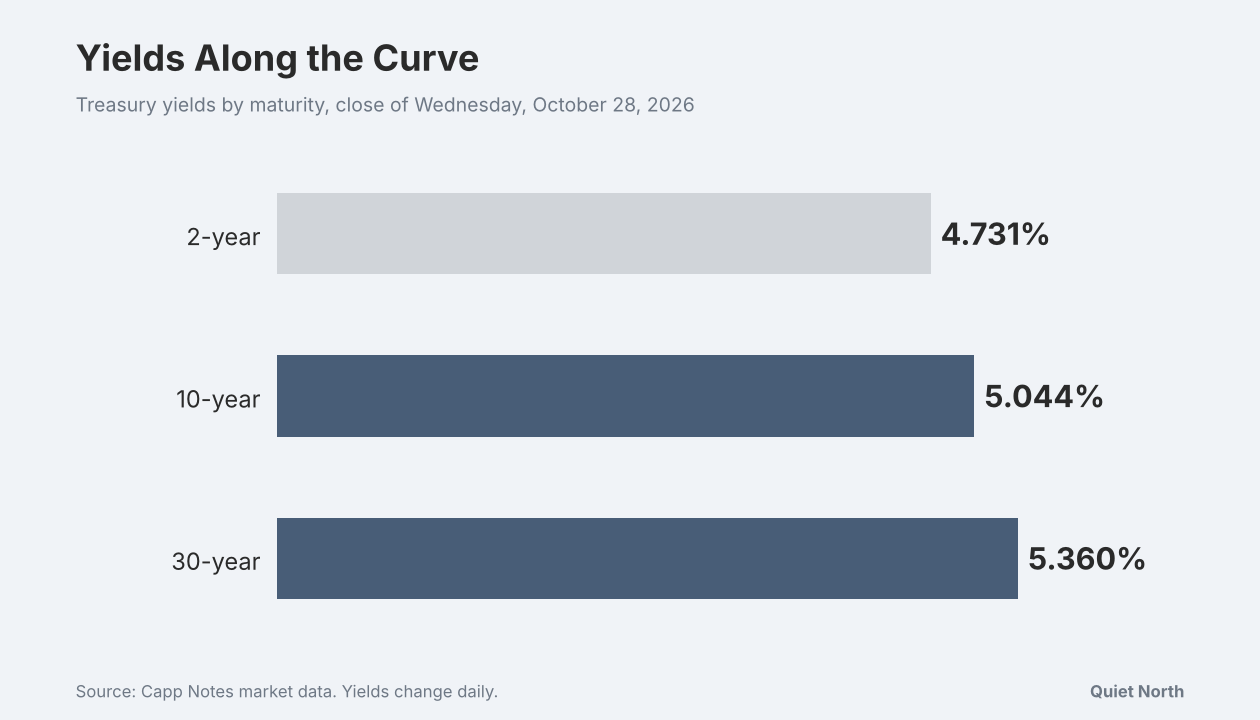
- The 10-year Treasury yield closed Wednesday at about 5.04%, according to market data compiled by Capp Notes.
- Alphabet fell about 13% in midday trading, per Yahoo Finance, after reporting results.

The Fed held, but did not close the door
The Fed kept its target range at 3.75% to 4.00% on Wednesday. The vote was 10-2, down from 12-0 in September. Governor Lisa Cook and Cleveland Fed President Beth Hammack dissented in favor of a quarter-point increase.
Several words in the statement changed, according to Yahoo Finance's live coverage:
- "Maintain" replaced "raise" in describing the decision.
- Economic activity is now described as expanding at a "strong" pace, upgraded from "solid."
- Guidance language softened slightly, with "timely" replacing "timelier."
At his press conference, Chair Kevin Warsh did not commit to a next step. He called the weeks ahead an "information rich interval" and said, "It's our responsibility to get inflation down," according to the briefs.co summary. Futures put the chance of a December increase at roughly 82% to 84%, depending on the source and the hour. A hold is not a promise, and the odds move with each new report.
Growth was firm, and inflation stayed high
This morning's reports filled in the picture. The BEA's first estimate showed real GDP up 3.4% at an annual rate in the third quarter, versus about 3.2% expected, according to La Voce di New York. Q2 growth was 2.2%.
Inflation, by the Fed's preferred measure, was 3.6% over the past year in September, and core, which leaves out food and energy, was 3.1%. Both matched expectations. Prices rose 0.5% for the month, and La Voce reported that gasoline and other energy goods were up 9.2% in September alone. For comparison, the Labor Department's consumer price index showed 3.7% for September, as we reported earlier this month.
Strong growth with high inflation is the combination that keeps the Fed cautious. It also means cost-of-living pressure has not eased for households on fixed incomes, even as the economy expands.
Yields stayed near 5%, and gold slipped
Short and long rates moved differently on Wednesday. According to Capp Notes, the 10-year yield rose 5.2 basis points to 5.044%, and the 30-year rose to 5.360%, while the 2-year was little changed at 4.731%. The gap between the 2-year and 10-year widened to about 31 basis points. A basis point is one-hundredth of a percentage point. Investors seemed to be treating the Fed's pause as a delay, not an end to increases. By midday Thursday, the 10-year was near 5.00%, per Yahoo Finance.
Gold was at about $4,035 an ounce, down about 0.4%, in midday trading Thursday. Earlier in the morning, Kitco-based reports showed it near $4,022, down more than 1%. The reasoning cited is that gold pays no interest, so firm growth and a possible December hike make it less attractive on a given day. Gold's role is not one-directional, and this explanation is common but not proven.
Oil rose on Wednesday. WTI settled at about $102.78 and Brent at $115.32, according to Capp Notes, which tied the rise to fighting in Yemen and concern about renewed U.S. strikes on Iran. AAA's national average for regular gasoline was $4.2471 a gallon on October 28, and AAA noted that the winter-blend switch had helped pull prices down in recent weeks. That relief may be tested if crude stays above $100.
AI earnings: one rewarded, one punished
Two of the largest technology companies reported after the close on Wednesday, and the market reached different conclusions.
Microsoft beat expectations. Schwab reported that Azure cloud growth was 49%, and Saxo reported 48%, so the figure was close to 50% by either count. Capital spending was $45.2 billion, below the $50 billion analysts had expected, according to Schwab. Microsoft's shares rose after hours but were down about 1.4% in midday trading Thursday, per Yahoo Finance.
Alphabet missed. Third-quarter sales of $111.2 billion fell short of projections, and search advertising growth was below forecasts. Free cash flow was negative $9.1 billion, the second quarter in a row below zero, according to Saxo. Google Cloud was a bright spot, with revenue of $30.7 billion, up 103%, according to Schwab. Yahoo Finance said Alphabet was on track for its worst day since its 2004 public offering, with a loss of nearly $500 billion in market value. That figure is a midday estimate.
The Nasdaq was down about 1.2% at midday, while the Russell 2000 of smaller companies was up about 1.1%. AI spending now sits at the center of the market's mood, and the numbers can change before the close. Amazon reports after the close today.
For Medicare enrollees
CMS Deputy Administrator John Brooks urged people to compare options during Medicare open enrollment, which ends December 7, according to The Hill on October 28. Officials suggested using Medicare.gov to check updated provider directories and pharmacy lists, because plans can change meaningfully from year to year.
🔍 What This Means For You
- A hold is a pause, not a promise. Two officials wanted a hike, and markets still lean toward December.
- Growth and inflation are both high. GDP rose 3.4% while PCE inflation was 3.6%.
- Long-term yields did not fall. The 10-year closed Wednesday near 5.04%.
- AI results are splitting investors. Microsoft's capital spending came in lower than expected, while Alphabet's free cash flow was negative.
- Index averages can hide differences. The Nasdaq was down about 1.2% at midday while smaller companies rose.
❓ Today's question
"If the Fed held rates, why are Treasury yields still near 5%?"
The Fed sets a short-term rate, while longer-term yields reflect what investors expect for inflation, growth and Fed policy over many years. On Wednesday the 2-year yield barely moved, but the 10-year rose to about 5.04%, which suggests investors are watching for more increases. Strong growth and 3.6% inflation can keep longer yields elevated even when the Fed holds. Yields also depend on supply and demand for Treasury debt. A hold today does not fix where yields will be tomorrow.

On a day like this, the headline can say more than the numbers. The numbers say the economy is running firmly, prices are still rising, and the Fed has not finished deciding.
The next scheduled data will come before the December meeting. In the meantime, separating what is confirmed from what is expected remains a steadier way to read the news. 🔔
Regards,
David Ellison
Found this information useful?