
The week’s last numbers: mortgage rates dip, gold slips


🔵 U.S. stock futures pointed lower early this morning, Friday, October 30, as Amazon and Intel results added to a week of questions about artificial intelligence spending. The week ends with a mixed set of facts. Mortgage rates dipped, gold slid to about $4,000, energy companies reported strong profits, and the latest government data showed household incomes lagging behind prices.
Here is a briefing on what the week's final numbers show, what is confirmed, and what is still premarket or developing.
Key points
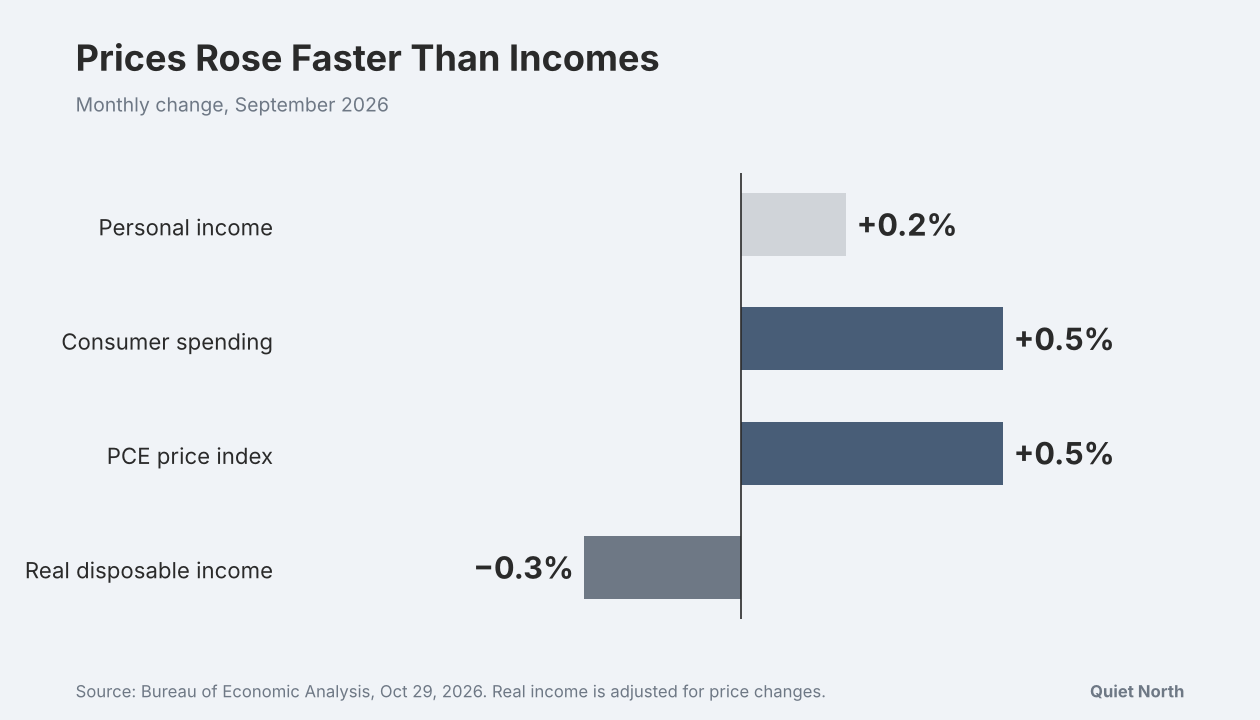
- Real disposable income fell 0.3% in September, while consumer spending rose 0.5%, according to the Bureau of Economic Analysis.
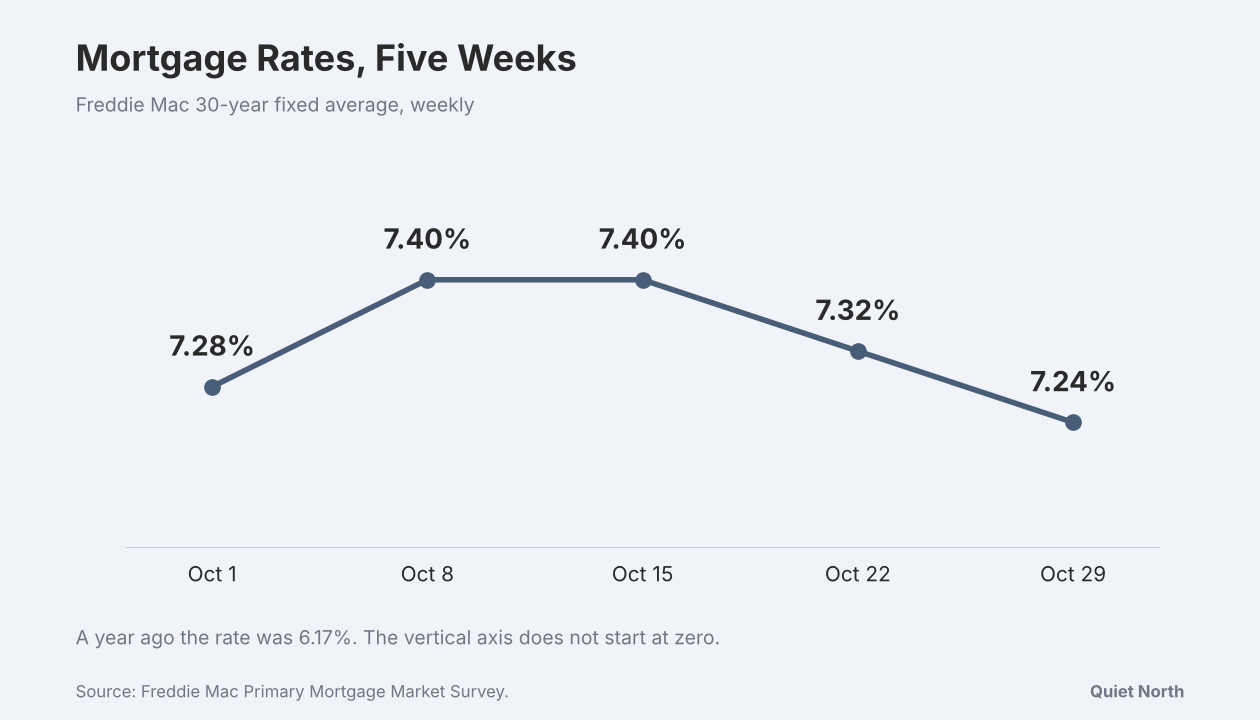
- The average 30-year mortgage rate fell to 7.24%, its lowest this month, Freddie Mac reported on October 29.
- Gold slipped to about $4,000 an ounce this morning and is on track for a second straight monthly decline, according to Reuters.
- Exxon and Chevron both beat profit estimates, helped by refining, they reported this morning.
- The Nasdaq fell 1.38% on Thursday while the Russell 2000 of smaller companies rose 1.01%.

The household budget: incomes lagged prices
The BEA's report on September, released Thursday, October 29, shows how the inflation numbers reached household finances. Here is what it found:
- Personal income rose 0.2% for the month.
- Real disposable income, which adjusts for prices, fell 0.3%.
- Spending rose 0.5% in dollars, but after adjusting for prices it was roughly flat.
- The personal saving rate was 3.8% of disposable income.
Inflation by the same measure was 3.6% over the past year, with core at 3.1%. The numbers suggest households kept spending while their purchasing power slipped, which is why the saving rate matters. Cost-of-living pressure is easiest to see for people on fixed incomes, because their payments do not rise each month with prices. Cost-of-living adjustments for Social Security are set once a year.
Mortgage rates dipped, and Treasury yields slipped below 5%
Freddie Mac reported that the average 30-year fixed mortgage rate fell to 7.24% this week from 7.32%, and the 15-year rate fell to 6.60%. Chief economist Sam Khater said the 30-year rate reached its lowest level this month. A year ago it was 6.17%.
The move follows Treasury yields. According to Capp Notes, the 10-year yield fell 7 basis points to 4.98% on Thursday, back under 5%. The 2-year fell to 4.61% and the 30-year to 5.32%. A basis point is one-hundredth of a percentage point. This morning the 10-year was about 4.94% in early trading, per Yahoo Finance.
A one-week dip of eight hundredths of a point does not change the broader picture. Rates remain more than a point above where they were a year ago, and futures still show a 75% to 78% chance of a Fed increase in December, depending on the source.
Energy companies reported strong profits
Exxon Mobil and Chevron both beat analyst profit expectations this morning, according to Reuters. Adjusted earnings were $4.23 a share at Exxon and $5.28 at Chevron. Refining was the driver. Exxon earned more from refining than from drilling for the first time in at least six years, and Chevron's refining profit was its highest for the period.
For dividend investors, the details are notable. Both companies used cash to reduce debt, by about $8 billion at Exxon and nearly $14 billion at Chevron, and Reuters said both are prioritizing balance sheets over higher payouts. Exxon will buy back $20 billion in shares in 2027, the same as in each of the last two years. Shares rose in premarket trading, about 2% at Exxon and 1% at Chevron.
Oil itself eased slightly on Thursday. WTI settled at $102.00 and Brent at $114.88, according to Capp Notes. Premarket quotes this morning varied by source, so we are not citing them. Energy costs are still the main driver of the inflation numbers above.
Gold slipped below $4,000, and tech remained under pressure
Spot gold was about $4,000.54 early this morning, down 0.5%, and December futures traded as low as $3,986.20, per Reuters and Yahoo Finance. Reuters tied the slide to higher oil and firm inflation data strengthening the case for a December rate hike. Yahoo also cited a report of a tanker being hit in the Strait of Hormuz, and that is still developing. Gold pays no interest, so gold's role tends to weaken when rate expectations rise, though that pattern is not reliable day to day.
In stocks, the S&P 500 fell 0.30% on Thursday to 7,720.39, and the Dow fell 0.25% to 52,342.56. Alphabet fell 12.64%, its worst day on record, according to Capp Notes. Most S&P 500 stocks rose, led by health care, real estate and consumer staples.
After the close, Amazon reported revenue of $201.9 billion, slightly below the $202.3 billion expected, according to Forbes, though cloud revenue grew 39%. Capital spending was $77.3 billion in the quarter. Amazon fell about 7% and Intel about 25% in premarket trading this morning, TheStreet reported, on weak guidance. These are premarket moves, and they may change by the close. The pattern is that AI spending is being questioned company by company, not all at once.
Medicare open enrollment: a reminder and a warning
Medicare open enrollment runs through December 7. The Better Business Bureau serving Quincy warned this week that scammers use the confusion around enrollment to ask for personal information. Warning signs include unsolicited calls, promised gifts, and callers who ask for payment to help pick a plan. Free help is available through the navigators listed at Medicare.gov, according to WGEM.
🔍 What This Means For You
- Prices have been rising faster than incomes. Real disposable income fell 0.3% in September.
- A thin saving rate leaves less cushion. It was 3.8% of disposable income.
- Mortgage rates eased but remain high. The 30-year average is 7.24%, against 6.17% a year ago.
- Energy profits come from refining. Exxon and Chevron beat estimates while crude stayed above $100.
- Gold's moves depend on rate expectations. It fell to about $4,000 as December hike odds stayed high.
❓ Today's question
"If mortgage rates fell this week, why do they still feel so high?"
Mortgage rates follow longer-term Treasury yields, plus a margin that lenders add. The 10-year yield is still near 5%, so mortgage rates stay elevated even after a small dip. The 30-year average of 7.24% is the lowest this month but compares with 6.17% a year ago. Weekly moves are usually small, and they depend on yields that change daily. One lower week is a data point, and it does not set a direction.

A week with both good and difficult numbers is a normal one. The useful habit is to read which figures are final, such as the BEA report and Freddie Mac's rate, and which are premarket quotes that may change by the close.
Next week brings the midterm elections on Tuesday, November 3. Until then, patience and clear sorting of facts is a steadier approach than reacting to each headline. 🔔
Regards,
David Ellison
Found this information useful?