
CDs near 4.4%, mortgages at 7.4%: what it means


🔵 U.S. markets are open today, Tuesday, October 20, after a calmer Monday that followed last week's technology selloff. The Federal Reserve is in its quiet period before its October 27 and 28 meeting, so the next few days will be driven by data and earnings, not Fed speeches.
Interest rates are the common thread in several stories this week. Higher rates are paying savers more, costing borrowers more, and weighing on housing. The Federal Trade Commission also released its annual report on fraud against older adults on Monday.
Here is a briefing on what happened and what is still unsettled.
Key points
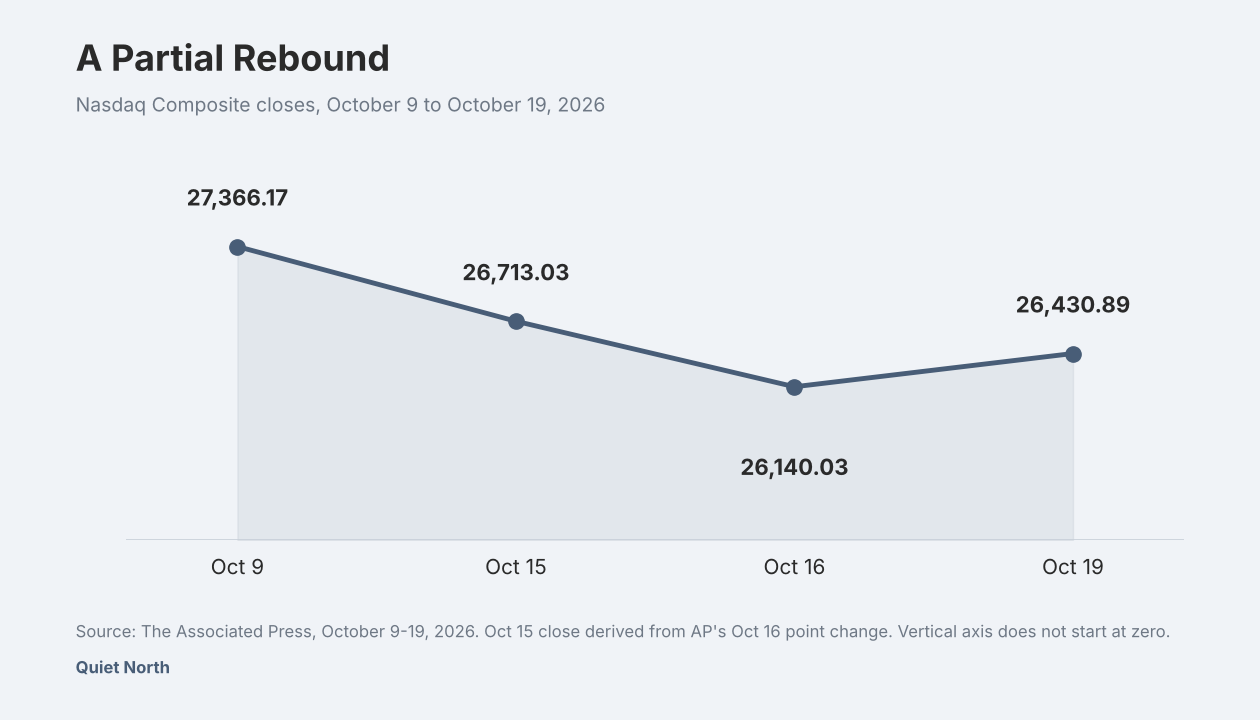
- Tech rebounded on Monday, October 19. The Nasdaq rose 1.1% to 26,430.89 after its worst week since June.
- The 10-year Treasury yield was about 5.1% on Monday, according to market reports.
- Builder confidence fell to 29, the lowest since 2012, the National Association of Home Builders reported on October 19.
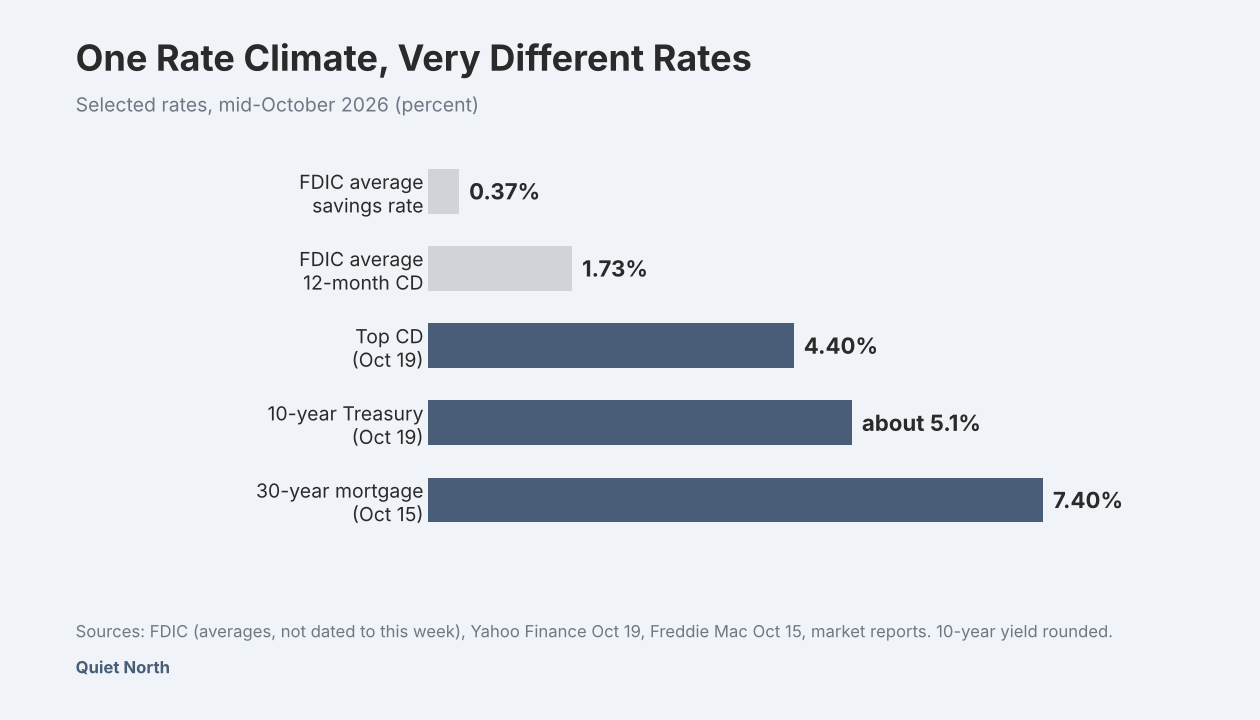
- The best CD rates are about 4.40%, while the FDIC national average savings rate is 0.37%.
- Older adults reported about $3 billion in fraud losses in 2025, the FTC said on October 19.

Tech rebounded on Monday, but the week's loss has not been recovered
Stocks mostly steadied on Monday. According to The Associated Press, the S&P 500 rose 0.4% to 7,690.73, the Nasdaq rose 1.1% to 26,430.89, and the Russell 2000 rose 0.3% to 2,728.30. The Dow slipped 0.1% to 51,966.03. Amazon, Palantir and Tesla led the gains, according to TheStreet, as chip and memory stocks recovered part of Friday's losses.
For the year, the Nasdaq is up 13.7%, the S&P 500 12.3%, the Russell 2000 9.9% and the Dow 8.1%. The Nasdaq closed at 27,366.17 on October 9 and at 26,140.03 on October 16, so Monday's bounce recovered only a small part of that decline. Market volatility has been higher, and earnings will test the mood: Netflix reports after the close today, and Tesla and Meta report after the close on Wednesday, October 21, according to TheStreet.
Yields eased, and markets lean toward a Fed pause
Treasury yields pulled back last week. Invezz reported that the 10-year yield fell about 16.5 basis points over the prior week, its biggest weekly decline since mid-February, and stood near 5.07% on Monday. FXStreet put it near 5.14% later in the day, so about 5.1% is a fair description. The 30-year yield was about 5.42%, according to Invezz.
Rate expectations have shifted. The Fed raised rates a quarter point in September, to a range of 3.75% to 4.00%. CME FedWatch shows more than an 85% chance that the Fed holds at its October meeting, according to Invezz, and about a 16% chance of a hike, according to FXStreet. Markets still see a December hike as likely, with estimates ranging from 74% (CBS, October 16) to about 92% (FXStreet, October 19). These odds change daily.
Oil remains a complicating factor. Crude eased early Monday after the U.S. waived some Russia-related sanctions, then rose again after Houthi attacks on Saudi targets, according to TheStreet. Sources differ on where it finished, but both benchmarks stayed near or above $100 a barrel. Gold fell about 0.5% to roughly $4,140 an ounce, according to FXStreet, as yields and the dollar rose.
Housing: higher rates are reaching builders
The NAHB/Wells Fargo Housing Market Index fell three points to 29 in October, the lowest reading since 2012, the NAHB reported on October 19. 43% of builders cut prices this month, the highest share in the 2020 to 2026 period, with the average cut at 6%. NAHB Chairman Bill Owens said mortgage rates "have climbed well above 7% in recent weeks."
Freddie Mac reported the average 30-year mortgage at 7.40% on October 15, unchanged for the week and up from 6.27% a year earlier. The 15-year average was 6.71%.
Housing starts for September are due this morning at 8:30 a.m. Eastern, with economists expecting about 1.30 million, according to Investing.com. The result may add to the picture.
Cash yields: savers are seeing a split
The same rate climate has produced a wide gap in what savers earn. According to Yahoo Finance on October 19:
- The top CD rate is 4.40% APY, offered by Capital One on an 11-month term and Marcus by Goldman Sachs on a 12-month term.
- The top high-yield savings rate is 4.3% APY, at Bask Bank, and that rate includes a 0.4-point bonus with conditions.
- The FDIC national average savings rate is 0.37%, and its 12-month CD average is 1.73%, though the CD figure is not dated to this week.
The top rates are above the 3.7% September inflation rate that the Bureau of Labor Statistics reported on October 14, while the national averages are well below it. Which rate a household earns depends on where the money is held.
Fraud: the FTC's annual report on older adults
On October 19, the FTC reported that adults 60 and older reported roughly $3 billion in fraud losses in 2025, about five times the 2020 figure of $600 million. Investment scams caused the most losses, rising 42% to more than $1 billion, and consumers often said scammers contacted them through social media. The FTC said it will never demand money, make threats or tell people to transfer money, and fraud can be reported at ReportFraud.ftc.gov.
🔍 What This Means For You
- Rates cut both ways. The same climate that lifts CD rates to 4.40% has pushed the 30-year mortgage to 7.40%.
- Averages and top rates are far apart. The FDIC savings average is 0.37%, against 4.3% at the best online banks.
- A rebound is not a recovery yet. The Nasdaq is still below its October 9 close of 27,366.17.
- The Fed is quiet, not finished. Markets expect a hold on October 28, with a December hike still likely.
- Fraud is rising where money is. Investment scams drew the largest losses reported by older adults in 2025.
❓ Today's question
"Why can a CD pay about 4.4% when a mortgage costs 7.4%?"
The two rates come from different places. Savings and CD rates follow the Federal Reserve's policy rate and competition among banks for deposits. Mortgage rates follow longer-term Treasury yields, such as the 10-year near 5.1%, plus a margin lenders add for risk and costs. Banks also pay depositors less than they charge borrowers, and that gap is how they earn money. The gap between a top CD and a mortgage is therefore not unusual, and it can widen or narrow as yields move.

Weeks like this one show how one number can sit in several stories. A yield above 5% is good news for a saver and bad news for a home buyer, and a builder's confidence reading says as much about the mortgage market as about construction.
Markets will keep moving, and so will the odds. A steadier way to read the news is to ask which number a headline actually changes for your own household, and which it does not. 🔔
Regards,
David Ellison
Found this information useful?