
Good news, high prices: what Tuesday’s data really said


🔵 The Federal Reserve announces its decision this afternoon, Wednesday, October 28, and the economy has just delivered a set of numbers that point in different directions. Consumers sounded more confident on Tuesday, factories reported more orders, and stocks rallied. Oil is still above $100 a barrel, and one of the largest U.S. employers is offering buyouts to about 60,000 people.
Here is a briefing on what the latest data shows, what is confirmed, and what is still a report or a forecast.
Key points
- The S&P 500 rose 0.6% on Tuesday, October 27, to 7,722.60, and the Nasdaq rose 1.2%, according to TheStreet.
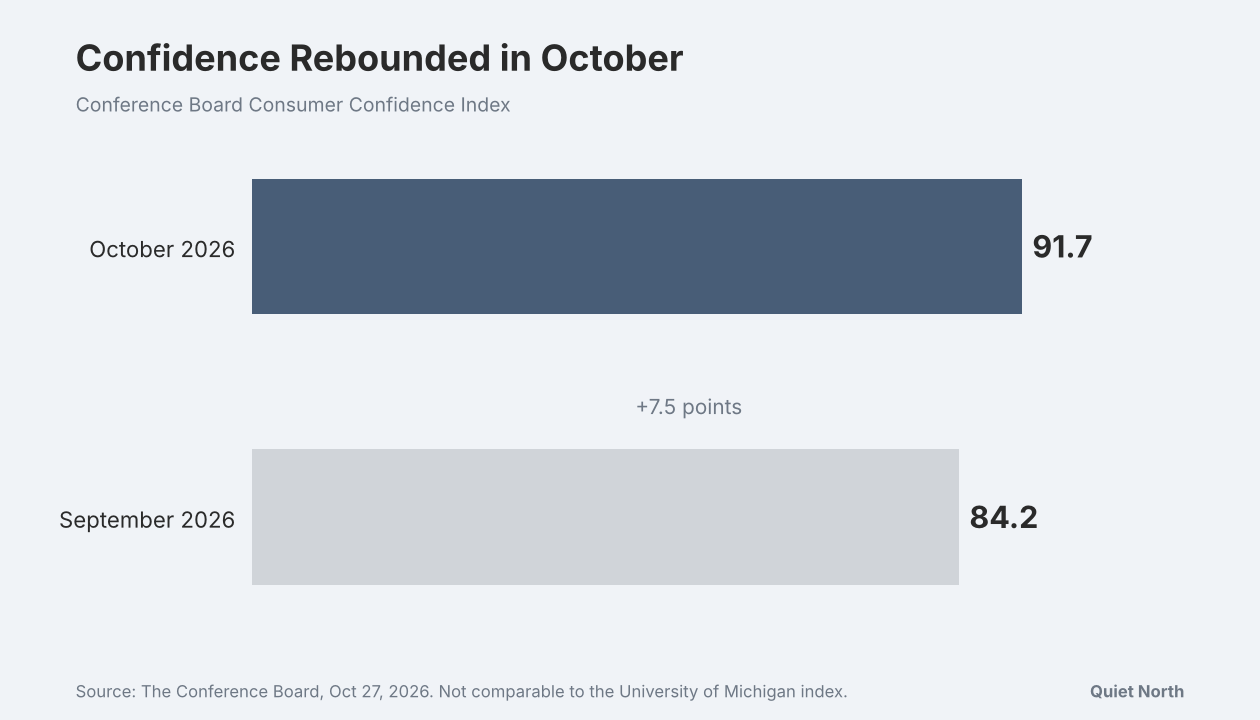
- Consumer confidence jumped to 91.7 in October from 84.2 in September, the Conference Board reported.
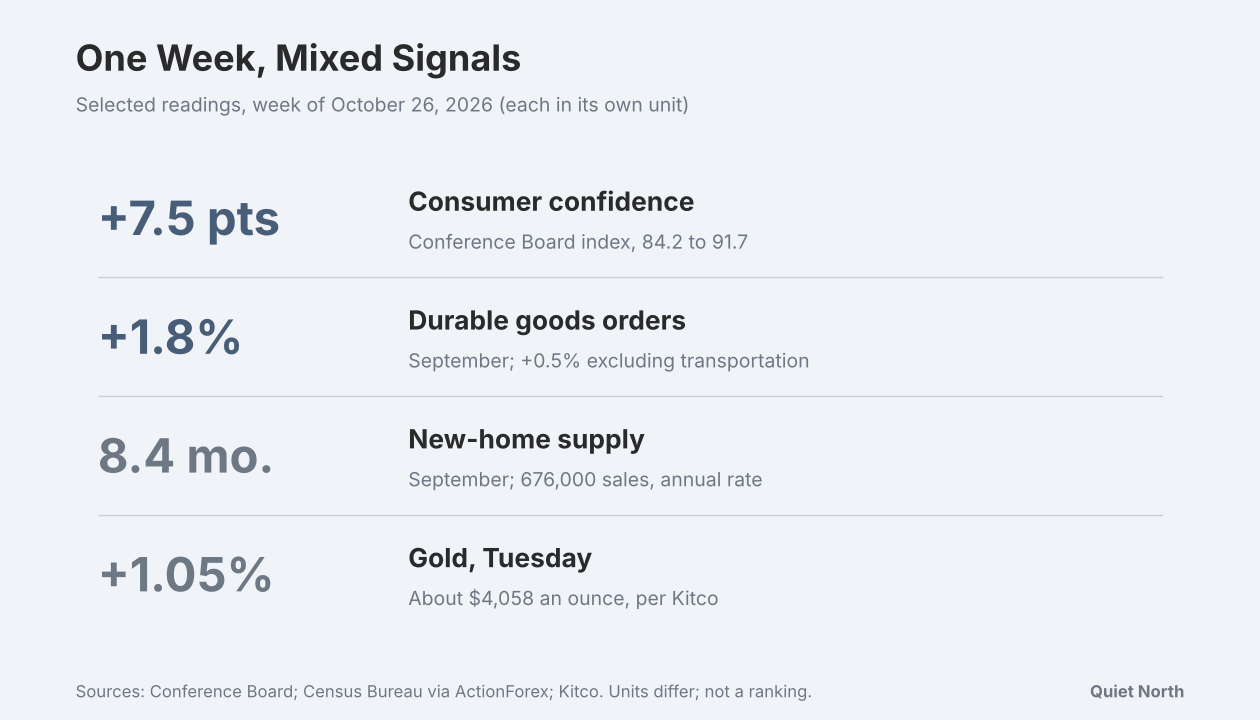
- Durable goods orders rose 1.8% in September, but excluding transportation the gain was 0.5%.
- Microsoft is offering voluntary buyouts to about 60,000 employees, and the company has confirmed the program.
- Fed funds futures priced about a 90.6% chance of no change today and about a 73% chance of a hike by year-end, per Kitco.

Stocks rallied, led by technology
According to TheStreet's market wrap, the S&P 500 gained 45.83 points, or 0.6%, to 7,722.60 on Tuesday. The Nasdaq Composite rose 1.18% to 26,477.81, and the Russell 2000 of smaller companies rose 1.16% to 2,818.87. The Dow Jones Industrial Average was nearly flat, up 0.03% to 52,377.57.
Yahoo Finance's live coverage reported that Meta plans to raise up to $95 billion for its artificial intelligence buildout, including an initial $35 billion in stock, and that Nvidia said it would invest $3 billion. Those are reported plans, not completed transactions. Coca-Cola beat estimates but its shares slipped slightly, and UPS rose about 2% after raising its guidance.
The 10-year Treasury yield was about 4.99% in late trading, according to both Yahoo Finance and TheStreet, close to Monday's level. A calm bond market on a rally day is a small sign that investors are waiting for the Fed before making bigger moves.
Consumers sounded more confident
The Conference Board said its consumer confidence index rose 7.5 points to 91.7 in October, up from 84.2 in September. The index is built from a survey of households about current conditions and their expectations for the months ahead.
That is a different message from the University of Michigan's final October reading of 48.0, which we reported on Monday. The two surveys ask different questions and use different methods, and their levels are not directly comparable. Surveys of mood are not measures of spending, so the useful comparison is each survey against its own history, and both can be true at once.
Orders and homes: solid headlines, softer details
The Census Bureau's advance report showed durable goods orders, which cover long-lasting items from machinery to aircraft, up 1.8% in September, according to RTTNews and ActionForex. Most of the strength came from transportation equipment. Excluding transportation, orders rose 0.5%, and orders for core capital goods, a gauge of business investment that leaves out defense and aircraft, rose 0.5%, slower than August's 1.6%, according to ActionForex. Forecasts for the headline number varied by source, so we report only the result.
Housing gave a more cautious picture. New single-family home sales were 676,000 at an annual rate in September, and the supply of unsold new homes stood at 8.4 months. Six months is generally described as a balanced market, so 8.4 months suggests builders are carrying more unsold inventory than usual. That fits with last week's report that 43% of builders cut prices in October.
The takeaway is that the data is mixed in a useful way. Business investment and confidence improved, while housing remained slow under mortgage rates above 7%.
Oil stayed high, and gold rose
Crude eased on Tuesday but stayed expensive. WTI traded just below $100 a barrel at midday, according to TheStreet. Reports on Brent differed, from about $115.50 in early trading to below $110 later, so we are not citing a settlement. AP reported Brent at $116.72 on Friday, October 23, the highest since June 2022.
Kitco reported that spot gold gained about $42, or 1.05%, to roughly $4,058 an ounce in late U.S. trading, and attributed the move to falling crude prices easing inflation worries. Gold opened Monday near $4,012, its lowest since July, so the move is a partial recovery, and the reasons for its swings are still debated.
A large employer offers buyouts
Microsoft confirmed to TechCrunch on Monday that it is offering voluntary exit packages to about 60,000 employees, roughly a quarter of its workforce. KUOW reported that eligible employees are in the U.S., U.K., Canada and India and are below the vice president level, with sales and some other teams excluded. A company spokesperson said the package is comparable to its standard severance and that artificial intelligence is not driving the offer.
The program is voluntary, and how many people accept is not yet known. In an earlier early-retirement program this year, more than 30% of eligible workers accepted, according to TechCrunch. Microsoft reports earnings after the close today.
For a household, one company's offer is not the job market. Weekly jobless claims were 194,000 last week, a level economists regard as low, and that is the broader number to keep beside this one.
What is scheduled next
- Today, Wednesday, October 28: the Fed's decision and Chair Kevin Warsh's press conference, then earnings from Microsoft and Alphabet after the close.
- Thursday, October 29: third-quarter GDP and the Fed's preferred inflation gauge, followed by Amazon and Intel earnings.
- Friday, October 30: Exxon Mobil and Chevron report before the open.
🔍 What This Means For You
- A decision day is also a data day. Confidence, orders and housing arrived the day before the Fed.
- Two surveys can disagree. The Conference Board index is 91.7 and Michigan's is 48.0, and each should be read against its own history.
- Headlines can hide details. Durable goods rose 1.8%, but only 0.5% without transportation.
- Housing supply is building. New homes for sale equal 8.4 months of sales at the current pace.
- One company is not the whole labor market. Microsoft's offer is large, while jobless claims remain low.
❓ Today's question
"If confidence is up and orders are up, why does the Fed still worry?"
The Fed looks at inflation as well as growth, and strong demand can keep prices rising when supply is tight. Oil above $100 is one reason inflation has stayed high, and the Fed raised its rate a quarter point in September, to a range of 3.75% to 4.00%. A rise in confidence and orders does not cause inflation by itself, but officials may want more evidence that price increases are slowing before they pause. That is why futures show a hold today and still lean toward a hike by year-end. Those odds shift with each new data point.

A day with good news and high prices can feel contradictory. Both can be true, and the Fed's job today is to weigh them.
Tomorrow brings GDP and inflation numbers that will add to this picture. Until then, noting what is confirmed, what is reported and what is only expected is a steadier habit than reacting to each headline. 🔔
Regards,
David Ellison
Found this information useful?