
Oil below $76. SPCX cooling. Gold selling off. The week is settling


🔵 The Warsh Fed era began with a jolt. The Iran deal MOU was signed electronically, first tankers have already moved, and SpaceX has pulled back from its all-time high. The week that felt like the biggest in years is now settling into something quieter. Here is what the numbers actually say — and at the end of today's issue, a free planning guide for retirees worth keeping.
Key Points
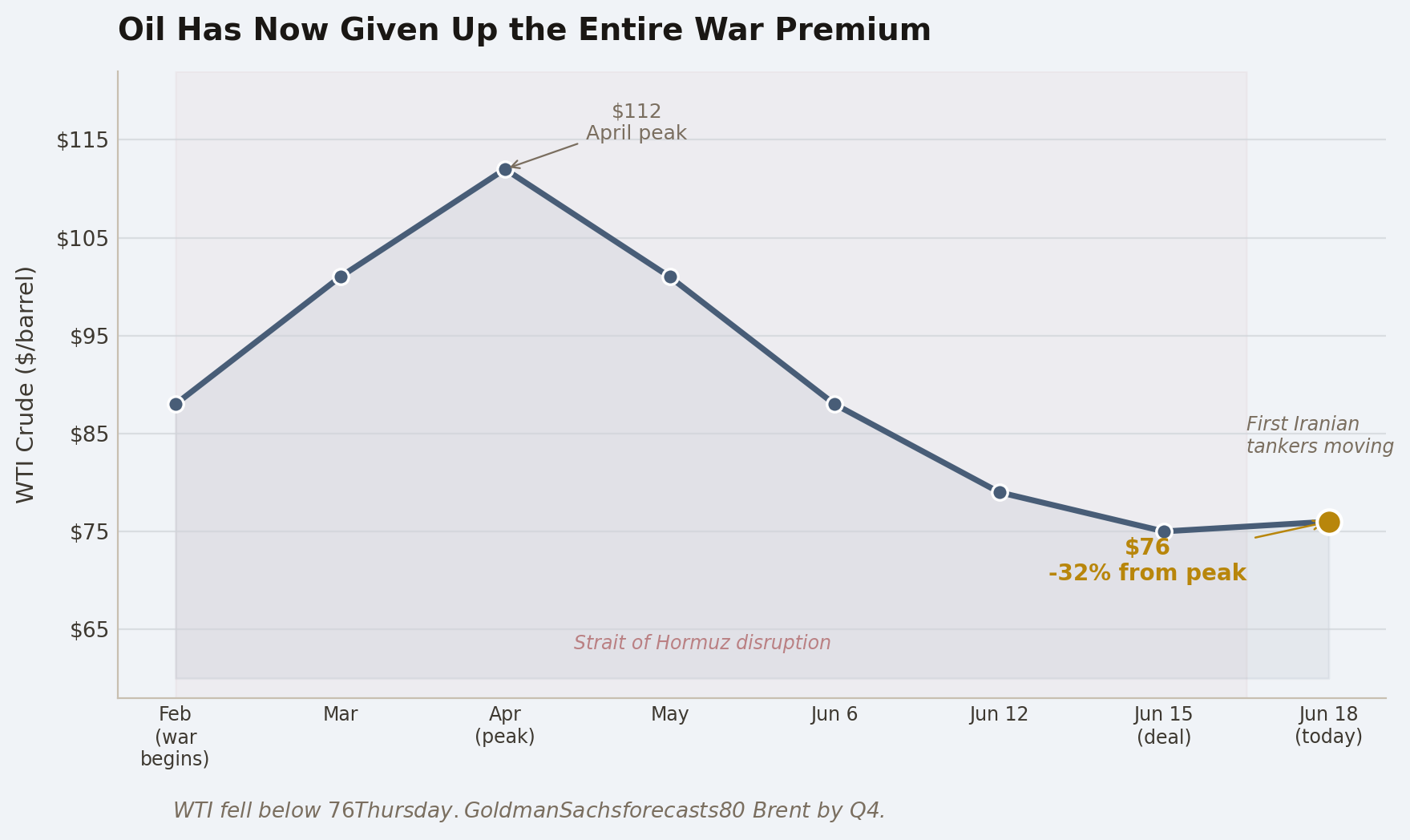
- WTI crude fell below $76 a barrel Thursday, its lowest level since early March, as Goldman Sachs cut its Brent forecast to $80 by Q4. The war premium built up since February has now been almost entirely unwound.
- The first Iranian oil tankers have already moved — two supertankers, "Diona" and "Hero 2," passed through the blockade zone carrying a combined 3.8 million barrels of crude, the first Iranian crude exports in two months.
- SPCX is trading near $192 today, pulling back from its all-time high of $225 reached Monday. The S&P 500 has formally declined to fast-track SpaceX into its index, citing a standard 12-month seasoning rule — meaning the trillions in S&P-tracking retirement funds will not automatically buy SPCX this year.

Oil Below $76 — And What That Actually Means for Inflation
The first tankers carrying Iranian crude oil have left the Strait of Hormuz since the U.S. naval blockade began two months ago. That physical fact matters more than any diplomatic document. Markets had been pricing in supply relief since the deal was announced Sunday; now, actual barrels are moving.
Goldman Sachs cut its oil price forecast, now expecting Brent crude at $80 per barrel in the fourth quarter of 2026, and projected Persian Gulf crude exports to return to pre-war levels by the end of July — one month earlier than previously expected. WTI, the U.S. benchmark, traded below $76 Thursday morning, a decline of roughly 32% from April's peak.
For retirees, the number that matters most sits downstream from oil: the CPI. Energy costs drove more than 60% of the May inflation surge that pushed headline CPI to 4.2%. The IEA warned of a potential supply glut, projecting global oil supply to increase by 8 million barrels per day by 2027 compared with demand growth of just 2 million barrels per day. If that projection holds, the energy-driven component of inflation does not just ease — it reverses. That would bring June and July CPI readings back toward the core rate of 2.9%, ease pressure on the Fed, and reduce the probability of the rate hike that three FOMC members projected Wednesday.
Worth noting: the deal is fragile. The memorandum gives Iran 60 days of toll-free passage through the Strait, after which the terms of future administration are to be negotiated with Oman. Trump said military action could resume if Iran failed to comply. Shipping companies remain cautious — the CEO of one of the world's largest tanker operators said his company will not send ships through the strait until the deal proves itself in practice, not just on paper. The direction is right; the durability is not yet confirmed.
Markets Are Repricing — Here Is What Changed and What Hasn't
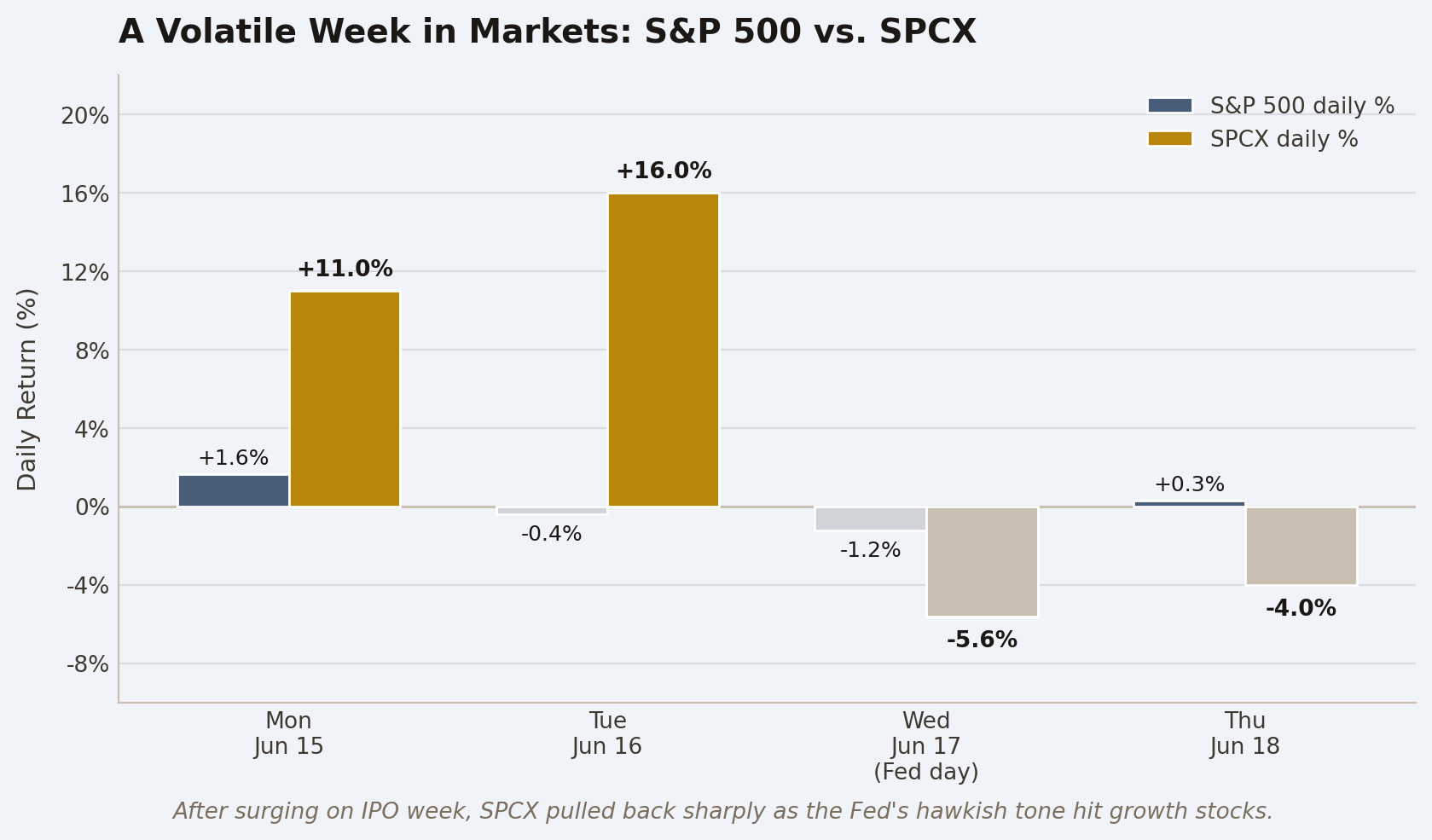
The Nasdaq fell sharply Wednesday — down roughly 6.7% — in the immediate aftermath of the Fed's hawkish-hold statement. That was the sharpest one-day drop since the chip selloff at the start of the month. It reflected a rapid repricing of growth stocks as investors absorbed the message that no cuts are coming this year and three officials are now penciling in a hike.
SPCX followed a different arc this week. SpaceX turned more than 3% lower Wednesday, poised to snap a post-IPO rally that had seen the company eclipse Amazon in market value in just three days of trading. By Thursday, shares were near $192, still up 42% from the $135 IPO price, but well off the $225 high reached Monday. That pullback is not unusual for a newly public company with a very small float — meaning very few of its shares are actually available to trade — and options markets adding volatility to the equation.
The S&P 500's index committee made a significant decision: no fast-track rule change for SpaceX. The standard 12-month seasoning period applies, meaning S&P 500 ETFs — which hold the retirement savings of tens of millions of Americans — will not automatically purchase SPCX shares this year. By contrast, Nasdaq-100 tracking funds are expected to begin adding the stock as early as late June or early July. If your fund benchmarks against the Nasdaq-100 rather than the S&P 500, you will own a small slice of SpaceX automatically. If it benchmarks against the S&P 500, you will not — at least not for another year.
Gold and silver, which had rallied strongly on the peace deal Monday, sold off Wednesday and Thursday as falling oil reduced the rate-hike fears that had been supporting both metals. Gold was near $4,250 Thursday, down from $4,370 at Monday's peak. That is a normal response: gold tends to rally when real interest rates — the rate after inflation — fall, and to pull back when inflation concerns ease and the rate environment stabilizes.
What This Means For You
The week's noise is fading. What remains is a cleaner picture: oil is unwinding toward pre-war levels, the Fed has told you what it plans to do (hold, not cut), and the stock market is sorting out which companies can justify their valuations without rate cuts as a tailwind. None of that requires action this week. It does clarify the planning context for the months ahead.
- If your index fund tracks the S&P 500, you will not automatically own SpaceX this year. If it tracks the Nasdaq-100, you likely will — within weeks. Check your fund's benchmark name on its fact sheet; this one detail changes your exposure meaningfully.
- The oil decline, if it holds through July, will show up in the June CPI report released in mid-July. That number — not this week's headlines — is the data point most worth waiting for before drawing conclusions about the inflation picture.
- Gold's pullback this week reflects easing rate-hike fears, not a reversal of longer-term demand. Central banks have been steady buyers; that structural demand does not change with a single week's price movement.
- With the Fed on hold and three members projecting a hike, short-term yields remain competitive at roughly 4.4–4.5%. Cash in Treasuries or money market funds continues to earn real income. No reason to extend duration to chase yield right now.
❓ Today’s Question
"Oil is falling fast. Does that mean gasoline prices will drop at the pump soon?"
Short answer: Yes, but the timing involves a lag. Crude oil prices feed into gasoline with roughly a four-to-six-week delay — refineries need time to process the cheaper crude, and the pump price reflects contracts and pipeline timing rather than today's spot price. A move from $112 to $76 in oil is substantial, and if it holds, consumers should begin to see lower pump prices by mid-to-late July. The EIA publishes weekly retail gasoline data every Monday morning; checking that figure once a week is the cleanest way to watch the pass-through happen in real time, without relying on news headlines that often trail the actual numbers.

I have been at this long enough to know that the weeks after a major event are often more revealing than the event itself. The Warsh Fed statement, the deal's first tankers, SPCX's first pullback — these are not setbacks. They are the market finding its footing after a week that moved faster than usual. The underlying picture is actually clearer now than it was seven days ago: oil is flowing, inflation has a relief valve, and the Fed has told you plainly what it intends. That is more than you had at the start of the month. Sometimes the most important thing is simply to wait for the picture to sharpen. This week, it did. 🔔
Regards,
David Ellison