
The jobs report lands today — here's what it means for rates and income


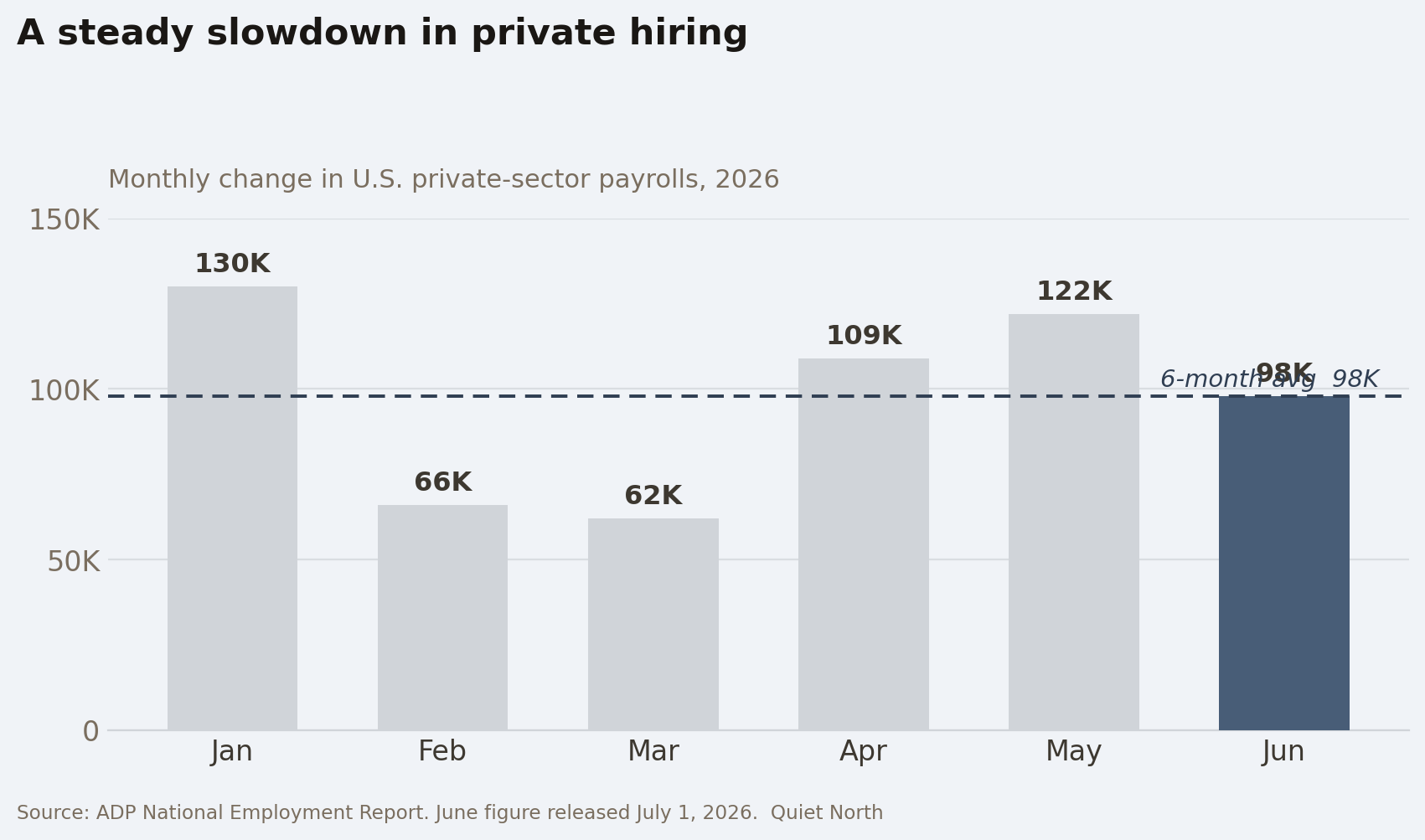
🔵 At 8:30 this morning, the government released its June jobs report a full day earlier than usual, because markets close tomorrow for the Independence Day weekend. Whatever the exact figure, the direction has been clear all week: hiring in America is cooling. Private employers added just 98,000 jobs in June, according to the ADP report released Wednesday — below forecasts, and down from 122,000 in May. This is not a collapse. It is a gradual downshift, and it happens to be the single most important thing the Federal Reserve will weigh when it meets on July 29. For anyone who depends on interest rates — which is to say, every saver and retiree — this week's numbers matter. Here is the calm read on what they mean.
Key points
- Private hiring slowed to 98,000 in June (ADP), the softest reading since spring and below the 110,000 economists expected.
- The June government jobs report arrived today, a day early; economists looked for around 110,000 jobs and unemployment near 4.3%.
- Treasury yields rose to about 4.48% as the second half began, a reminder that bond prices and income move with these numbers.

A slowing job market sounds like bad news, and for those looking for work it can be. But for the broader economy — and for the interest-rate picture that shapes retirement income — the story is more balanced than the headline suggests.
The cooling is real, but uneven — and concentrated in one place
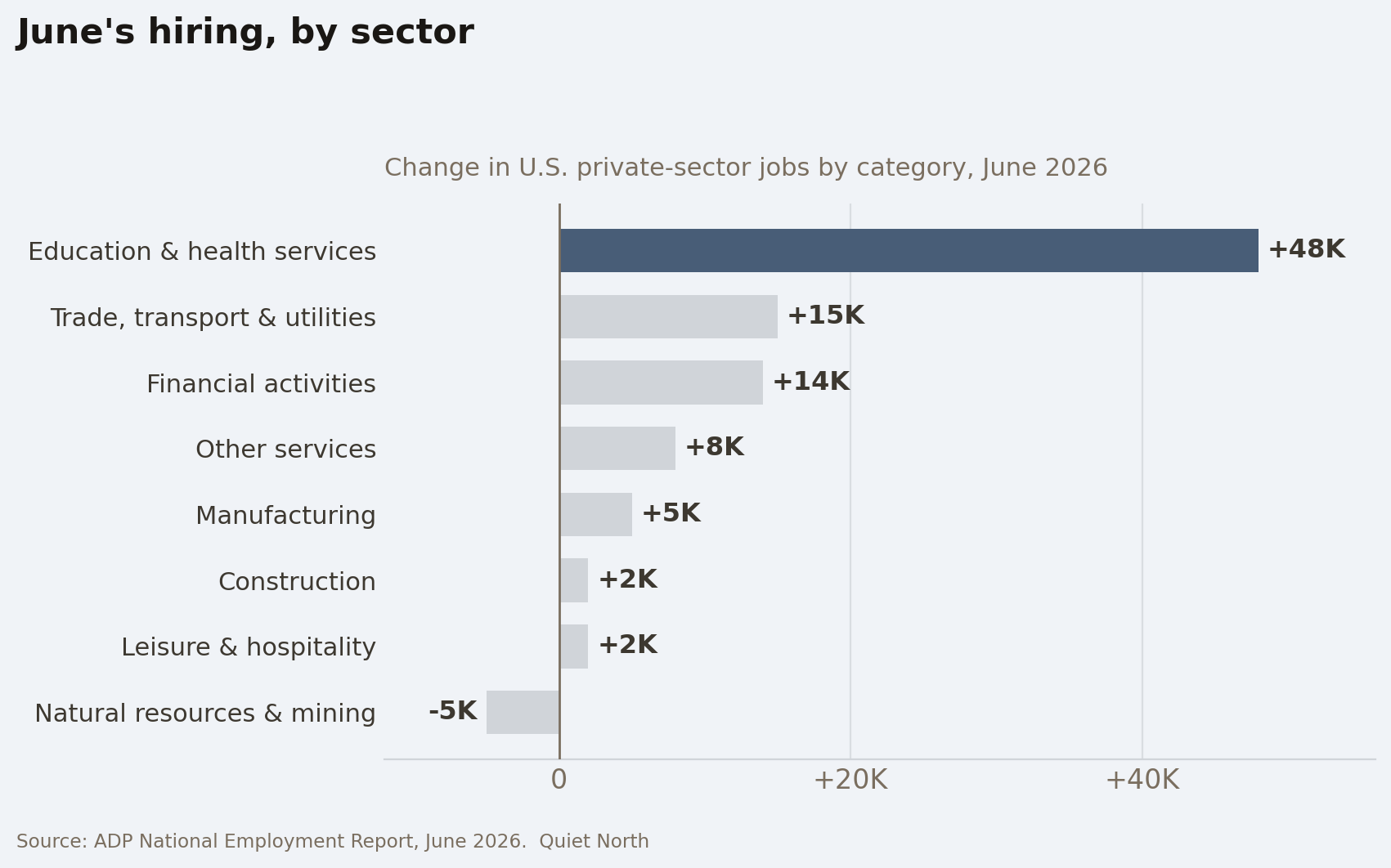
The most striking feature of June's hiring was not that it slowed, but where the jobs came from. Nearly half of all private hiring — 48,000 of 98,000 positions — came from a single category: education and health services. Meanwhile, leisure and hospitality, often a barometer of everyday consumer demand, added just 2,000 jobs, its sixth weak month in a row.
A quick look at where June's private jobs came from:
- Education and health services: +48,000 — nearly half the total, and a consistent leader all year.
- Trade, transportation, and utilities: +15,000.
- Financial activities: +14,000.
- Manufacturing and construction: +5,000 and +2,000 — modest but positive.
- Natural resources and mining: −5,000 — the only category that shrank.
Why does this concentration matter to older Americans? Because healthcare is both the part of the economy still reliably expanding and the part most of us lean on more heavily with age. Steady hiring there is a quiet sign of stability in a sector that touches every retirement. It also helps explain a stubborn fact: healthcare costs keep rising in part because demand for healthcare workers keeps growing. The cost-of-living pressure many readers feel most acutely — in medical bills and insurance premiums — has a labor market behind it.
There is one more shift under the surface worth naming plainly.
AI is starting to show up in the layoff numbers
For the first time, artificial intelligence is a measurable force in the job data — not as a stock-market story, but as a workplace one. Of the 46,000 job cuts U.S. employers announced in June, the technology sector led with 16,000, attributed largely to AI. The total number of cuts actually fell sharply from May, so this is not a wave of layoffs. But it is a signal: the AI spending that has driven markets for two years is beginning to change how companies staff themselves, starting with white-collar and tech roles.
For most retirees, this is context rather than a call to action. But for those still working, helping adult children navigate careers, or holding technology stocks, it is a reminder that AI's effects are becoming concrete. What this means, in practical terms, is that the market's enthusiasm for AI and the economy's absorption of it are now two different stories moving at two different speeds.
What a cooling job market means for rates and income
Here is where it all connects for your savings. A softer labor market gives the Federal Reserve more room to hold rates steady rather than raise them — and that has direct consequences:
- If hiring keeps cooling, the case for a July rate hike weakens, which tends to support both bonds and rate-sensitive stocks like utilities and real estate.
- If today's report came in hot, it could revive hike talk, and markets could see some market volatility into the July 29 Fed meeting.
- Either way, cash yields remain attractive: short-term Treasuries and top CDs still pay near 4%, and a slower economy tends to keep those yields available longer.
New Fed Chair Kevin Warsh, in his first international appearance this week, pointedly declined to hint at what the Fed will do. That silence keeps every data point in play — including this morning's. Meanwhile, Treasury yields actually rose to around 4.48% on the 10-year as the second half began, a reminder that markets don't always move in the direction a single report suggests.
❓ Today's question
"If the job market is slowing, should I expect my bond and CD income to fall soon?"
Not necessarily, and not right away. Bond and CD yields are shaped by the Fed's rate decisions and by longer-term expectations for inflation, not by any single jobs report. This week, even as hiring data softened, the 10-year Treasury yield actually rose to about 4.48% — the opposite of what many would guess. If the economy cools enough that the Fed eventually cuts rates, newly issued CDs and short-term Treasuries would likely pay less over time, but existing fixed-rate holdings keep their agreed yield to maturity. The short version: today's income is locked in on what you already hold, and the future path depends on inflation as much as on jobs.
🔍 What this means for you
The week's data points in one direction — a slowing, narrowing job market — but the practical reading stays calm:
- A gentle slowdown is not a downturn. Job openings still number 7.6 million, and unemployment has held near 4.3% for months.
- Watch the Fed, not the headline. The July 29 meeting matters more than any single day's number, and a softer job market gives the Fed room to wait.
- Income remains steady. Near-4% yields on cash and short Treasuries are intact, and a cooling economy tends to preserve them.
- AI's real-world effects are worth following — not as a reason to trade, but as part of understanding the economy your savings live in.

I have found that the most useful thing during data-heavy weeks is not to predict the number, but to know what it changes and what it doesn't. Today's report will move headlines for a day. It will not, by itself, change a sound plan built on steady income and patience. The job market is cooling. The economy is still standing. And the task, as always, is to see clearly through the noise. 🔔
Regards,
David Ellison