
SpaceX Prices Today. Inflation Just Crossed 4%. Here Is What Matters


🔵 The largest IPO in stock market history is set to price after market close today. Yesterday's inflation report confirmed what energy prices had been signaling for months. And fresh U.S. strikes on Iran overnight remind us that the force behind both stories — oil — is far from resolved. A busy week, distilled.
Key Points
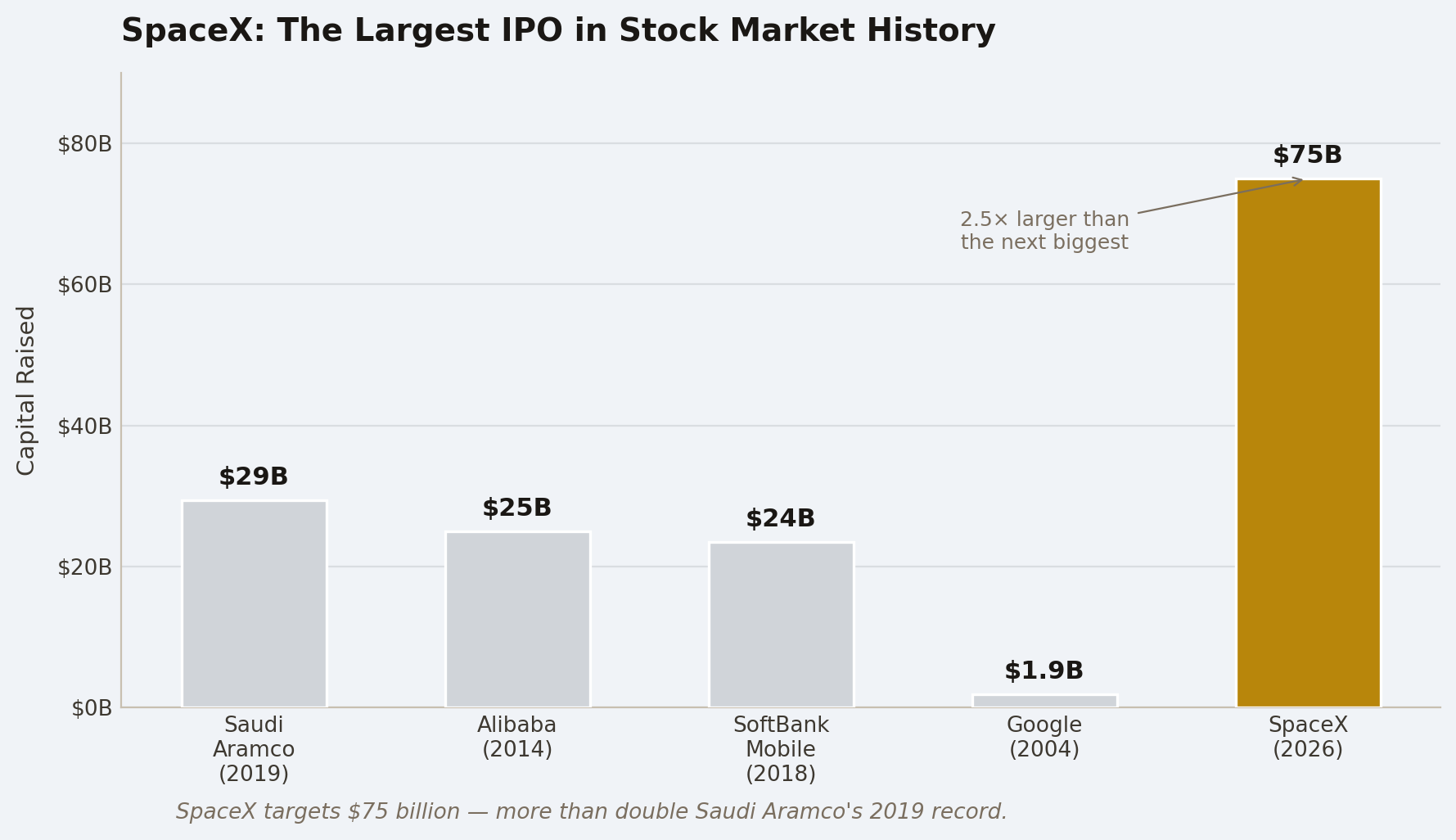
- SpaceX is expected to price its IPO today at $135 per share, targeting a $1.75 trillion valuation and a $75 billion raise — more than double Saudi Aramco's 2019 record. Trading begins tomorrow on the Nasdaq under the ticker SPCX.
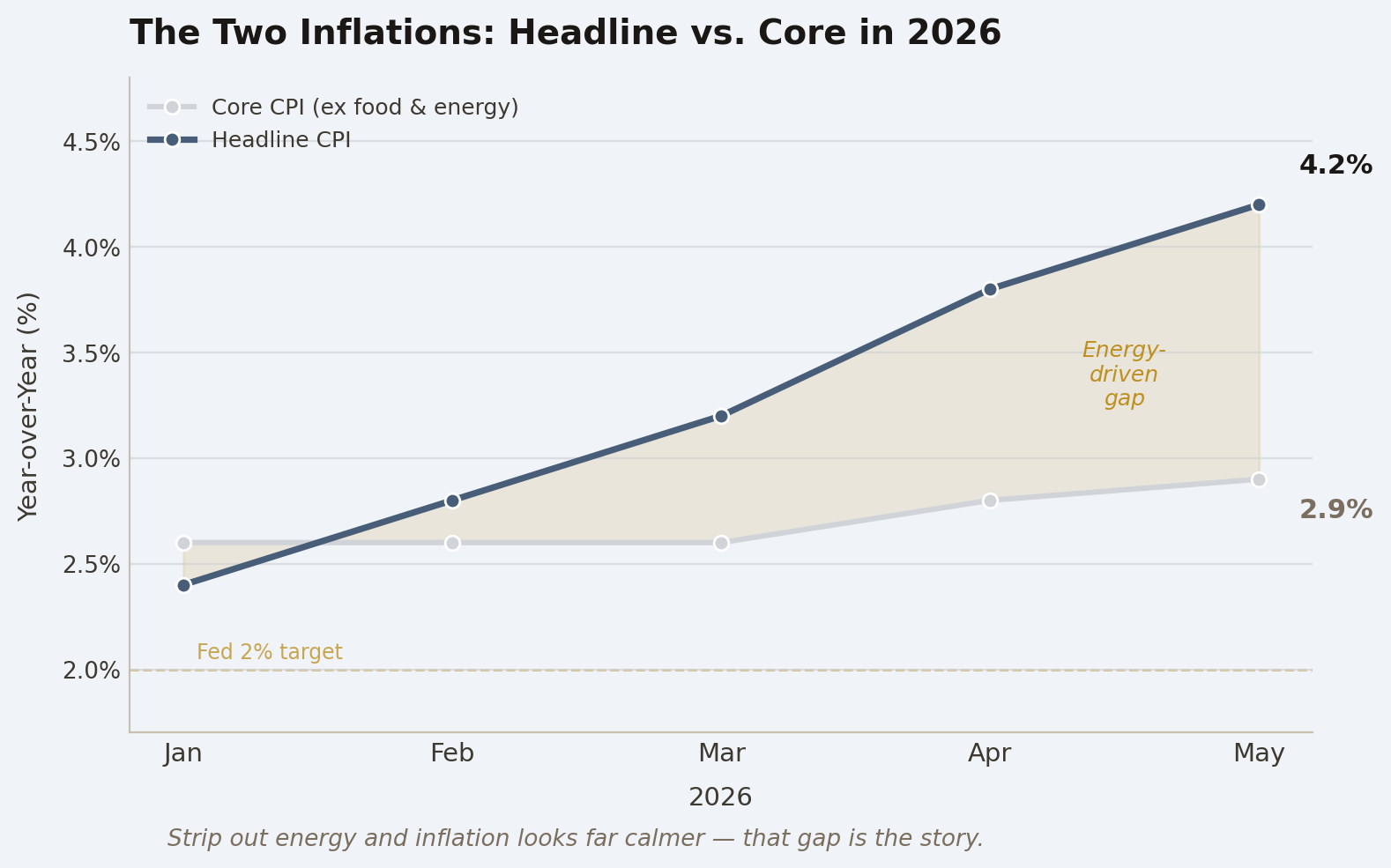
- Yesterday's May CPI came in at 4.2% year-over-year, the highest since April 2023. Energy prices accounted for over 60% of the increase. Core inflation, which strips out food and energy, was a calmer 2.9%.
- Markets fell sharply yesterday — the Dow lost 1.87%, the S&P 500 dropped 1.62%, and the Nasdaq slid nearly 2% — as new U.S. military strikes on Iran rattled investor confidence ahead of next week's Fed meeting.

The Biggest IPO in History — In Plain Terms
SpaceX expects to finalize its share price this evening at $135, selling roughly 556 million shares and targeting a raise of $75 billion. If it holds, this will be the largest initial public offering ever — more than 2.5 times the size of Saudi Aramco's $29 billion deal in 2019, and roughly 40 times what Google raised in 2004.
The demand has been striking. Reports indicate the offering is roughly 3.5 times oversubscribed, with over $250 billion in investor interest competing for $75 billion worth of shares. Up to 30% of the deal is reportedly allocated to individual investors — an unusually large retail slice for a deal of this magnitude. MSCI has confirmed fast-track index inclusion, meaning passive funds that track global indexes will likely be required to add the stock shortly after listing.
For retirees, the relevant question is not whether to participate. It is how a $75 billion capital raise affects the broader market they already own. When a deal this large absorbs investor capital in a single week, it can temporarily reduce liquidity elsewhere — one reason some analysts have attributed part of last week's selling pressure to pre-IPO fundraising. Whether or not that is the full explanation, the scale matters as context.
Worth noting: SpaceX reported $18.7 billion in 2025 revenue but a $4.9 billion net loss. Starlink — its satellite internet division — is the company's only profitable segment. The $1.75 trillion valuation works out to roughly 95 times annual sales. That does not mean the price is right or wrong. It means the market is pricing in years of future growth that have not happened yet, and that is the kind of assumption worth understanding clearly.
What Yesterday's Inflation Number Actually Tells Us
The May CPI report, released yesterday morning, confirmed what energy prices had been telegraphing. Headline inflation rose to 4.2% year-over-year — the fastest pace in three years. The monthly increase was 0.5%, driven almost entirely by a 3.9% jump in energy costs. That single category accounted for more than 60% of the total increase.
But there are two inflation stories running at once. Core CPI — which removes food and energy — came in at just 0.2% for the month and 2.9% year-over-year, actually below the 0.3% monthly consensus. In plain terms, if you strip out what the Strait of Hormuz is doing to oil, the underlying economy looks far less inflationary than the headline suggests.
That gap — 130 basis points between headline and core — is the single most important number in this report. If it narrows because core rises, that is genuinely concerning. If it narrows because energy falls, that is the scenario markets are hoping for.
For now, the Fed is almost certainly staying on hold at next week's June 17 meeting. But futures markets are pricing in a 100% probability of a rate hike by December. That has direct consequences for bond prices, mortgage rates, and how much new cash earns in a money market fund.
I remember the early 1990s, when oil's role in driving headline inflation led the Fed into a difficult corner — raising rates into an economy that was already slowing. The parallels are not exact. But the mechanism is familiar: energy costs push up the number the public sees, even when broader price pressures are contained. The honest answer is that the Fed's job gets harder from here, and nobody knows how they will resolve the tension between an oil-driven headline and a calmer core.
What This Means For You
Two major events — the inflation report and the IPO — landed in the same week, and both are generating headlines. Neither requires immediate action from an income-focused retiree. The inflation data tells you where prices have been, not where they are going; the IPO tells you that capital is moving, not that your portfolio needs to move with it. Focus on structure, not on the news cycle.
- Check your money market or savings rate against current short-term Treasury yields — with the 10-year near 4.53% and short-term rates competitive, idle cash in a low-yield account is losing ground to inflation every month.
- If you own a bond fund, look at its average duration; a rate hike is now priced as more likely than a cut, and longer-duration funds will feel that pressure more than shorter ones.
- Review whether any of your holdings overlap heavily with the Nasdaq or mega-cap growth — yesterday's 2% drop in the Nasdaq, driven by tech selling, is a reminder of where concentration risk sits.
- Note that the Producer Price Index — what businesses pay for goods and services — is due tomorrow. It will offer a second data point on whether inflation pressures are broadening or staying concentrated in energy.
❓ Today’s Question
"If SpaceX enters the major indexes quickly, does that mean my index fund will automatically buy it — and should I care?"
Short answer: Yes, if MSCI confirms fast-track inclusion, funds that track the MSCI World or MSCI ACWI indexes would be required to add SpaceX shares proportionally. For the S&P 500, the timeline depends on the index committee's discretion, though a company this large would likely be considered quickly. The practical effect is that a small slice of your existing index fund's future purchases would flow toward this single name.
For most retirees, that incremental addition is small relative to the fund's total holdings and does not require action. The concrete step: if you want to know whether your fund tracks an index that would include SpaceX, check the fund's benchmark name on its fact sheet — MSCI World, S&P 500, or Nasdaq-100 are the most common — and that will tell you whether the stock will enter your portfolio automatically.

This is one of those weeks where the sheer volume of news can make it feel like something important is being missed. Inflation data, the largest IPO in history, new military strikes, oil moving, markets falling — it all arrives at once. But I have found, over many years and many cycles, that the weeks with the most moving parts are the weeks where stillness serves you best. The structure you built before this week started is the same structure that carries you through it. Nothing about today's headlines changes what steady income is for, or what patience earns over time. 🔔
Regards,
David Ellison