
The deal is done. Oil is falling. Here is what it means for your money.


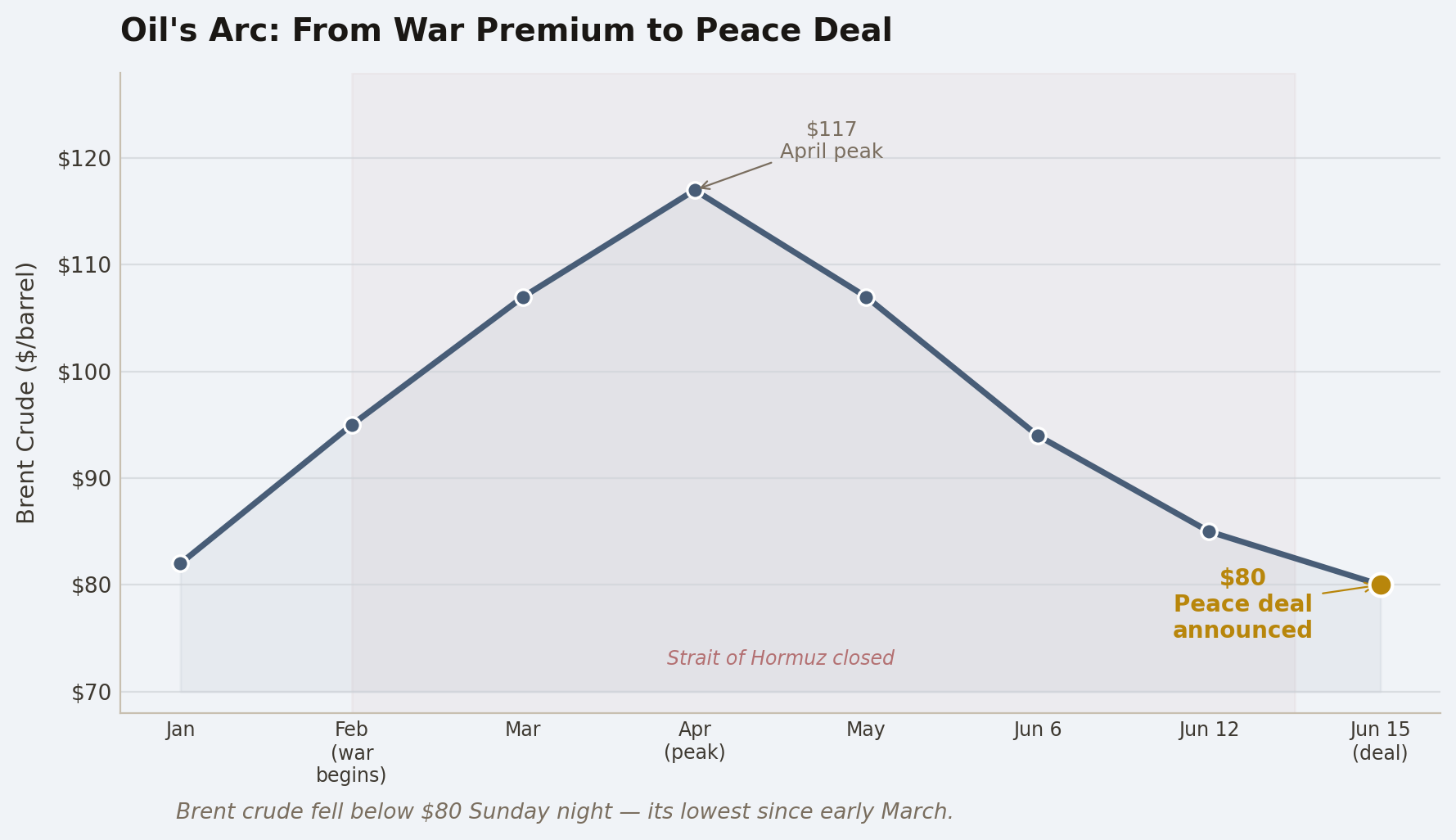
🔵 The U.S. and Iran announced a peace deal late Sunday — formally ending the conflict that has disrupted 20% of the world's oil supply since late February. Brent crude fell below $80 a barrel overnight, its lowest since early March. For retirees who have watched energy-driven inflation eat into every fixed dollar for four months, this is the most consequential development of the year. Here is what it means.
Key Points
- The U.S.-Iran peace deal was announced Sunday evening. The Strait of Hormuz — the narrow waterway through which roughly a fifth of global oil once passed — is authorized to reopen, with a formal signing scheduled for Friday in Switzerland.
- Oil prices dropped sharply overnight: Brent crude fell to roughly $80 per barrel, down from $94 at the start of last week and $117 at April's peak. WTI crude touched $80, its lowest since early March.
- The Fed's two-day meeting begins tomorrow. Wednesday's rate decision was already expected to be a hold — but if oil continues falling, the inflation picture that forced rate-hike talk could shift meaningfully.

What the Peace Deal Means — And What It Does Not
The agreement, mediated by Pakistan, calls for an immediate and permanent end to military operations on all fronts, the toll-free reopening of the Strait of Hormuz, and the removal of the U.S. naval blockade. A signing ceremony is expected Friday in Geneva.
The market reacted immediately. Brent crude dropped more than 4% overnight to roughly $80 — a decline of nearly 32% from April's peak of $117. WTI crude fell about 5.5% to $80. In plain terms, the war premium that has been built into every barrel of oil since February is now unwinding.
What this does not mean — yet — is that energy prices will return to pre-war levels overnight. Mine clearance in the strait could take weeks. Shipping routes will need to be re-insured and rebuilt. And the agreement itself must survive technical negotiations and a formal signing before it becomes permanent. Markets are pricing in hope. The actual flow of oil will take longer.
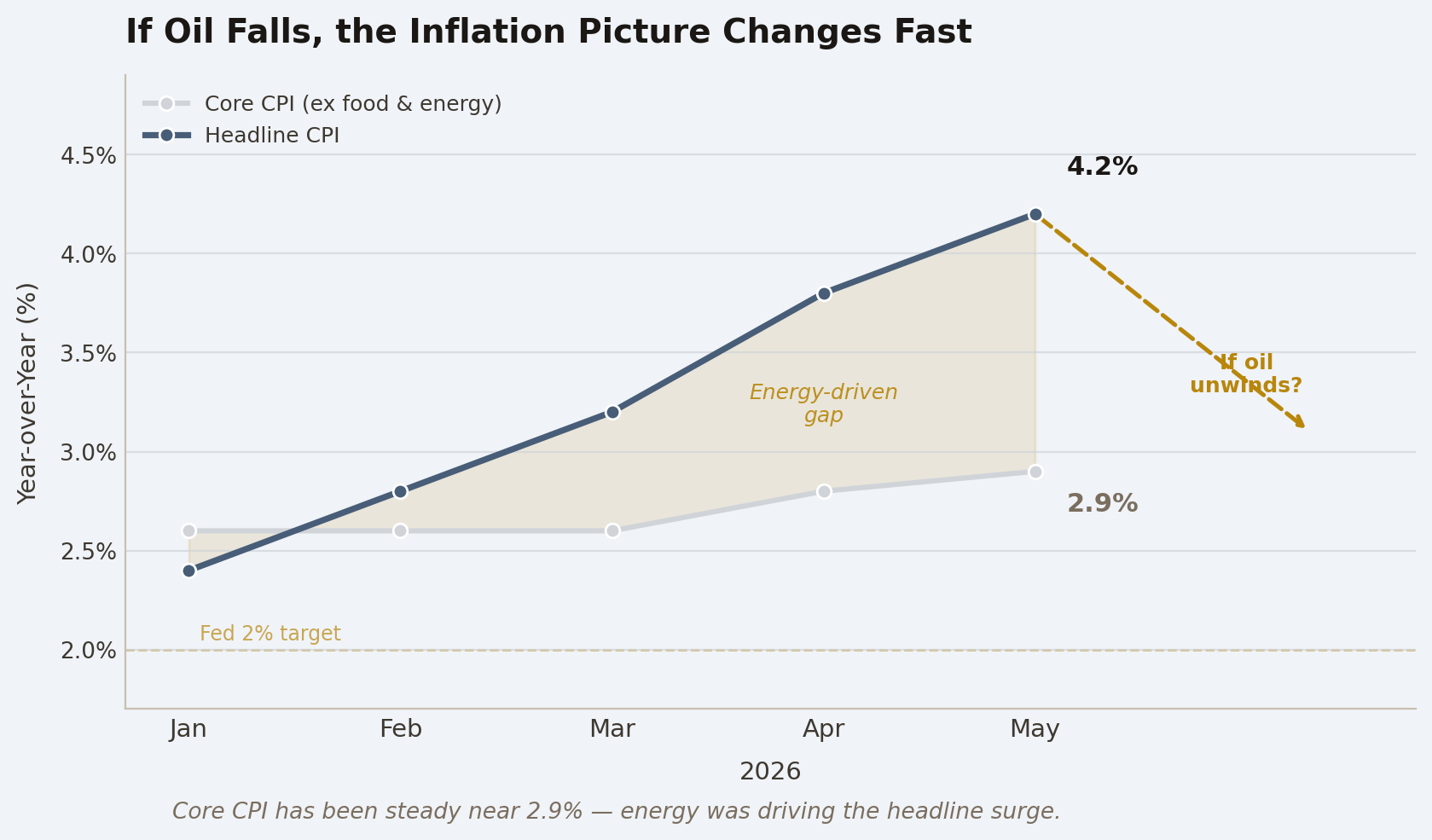
But the direction matters enormously. Energy costs accounted for over 60% of the May CPI increase that pushed headline inflation to 4.2%. If oil stays near $80 — or falls further — that energy-driven pressure begins to ease in the June and July data, and the inflation picture changes materially.
The Fed Meeting Just Got More Interesting
The Federal Open Market Committee — the Fed's rate-setting body — begins its two-day meeting tomorrow, with a decision due Wednesday afternoon. Before Sunday's deal, the market had fully priced in a rate hold this week and a 100% probability of a rate hike by December.
That calculus may now shift. If oil falls further and energy costs begin to recede, the Fed's primary reason for considering a hike — headline inflation running above 4% — weakens. Core inflation, which strips out food and energy, has been running at a far steadier 2.9%. The gap between the two has been the story of 2026, and a peace deal begins to close it.
Worth noting: wholesale inflation — measured by Thursday's Producer Price Index — came in hot at 6.5% year-over-year, the highest since late 2022. That reflects what businesses are paying, and it does not reverse overnight. But the PPI is also heavily weighted toward energy, and a sustained drop in oil would pull it lower in coming months.
I remember the fall of 1991, when oil's decline after the Gulf War ceasefire gave the Fed room to cut rates through the end of the year — a quiet tailwind that helped bonds rally and gave retirees a window of improving income. The honest answer is that nobody knows whether this deal will hold or how quickly the inflation picture clears. But the mechanism is familiar, and the direction is meaningful.
SpaceX: a quick update. Friday's debut went as expected. Shares opened at $150, touched $176 intraday, and closed at $161 — up 19% from the $135 IPO price. SpaceX is now the sixth-largest publicly traded company in the United States. Elon Musk's net worth crossed $1 trillion, making him the world's first trillionaire by that measure. For index fund holders: MSCI has confirmed fast-track inclusion, meaning passive funds will begin adding the stock in the coming weeks. No action is needed on your part — your fund will adjust automatically.
What This Means For You
The peace deal is the single most important development for retirement income since the war began. If it holds, the energy-driven inflation that has been eroding purchasing power for four months starts to unwind — and the Fed's path gets simpler. None of this is guaranteed. But the direction has shifted, and that is worth acknowledging calmly.
- Watch Wednesday's Fed statement closely — not for the rate decision (a hold is expected) but for the tone. If the language around inflation softens in response to falling oil, it signals that rate-hike odds may ease, which would help bond prices.
- If you have been holding cash in short-term Treasuries or money market funds, the income they generate remains competitive at roughly 4.5%. There is no reason to move that money based on a single weekend's news.
- Gasoline prices at the pump will take weeks to reflect the oil decline — pipeline and refinery lags mean retail gas typically trails crude by 4 to 6 weeks. Budget accordingly.
- For the Social Security COLA: the 2027 adjustment is calculated using July, August, and September CPI-W data. If oil continues falling through the summer, the COLA could come in lower than recent inflation rates would suggest — a mixed blessing that means both less adjustment and less erosion.
❓ Today’s Question
"If oil keeps falling, does that mean inflation is over?"
Short answer: Not quite. Oil falling removes the largest single driver of this year's inflation spike, but it does not eliminate inflation entirely. Core CPI — which excludes food and energy — is still running at 2.9%, above the Fed's 2% target. Housing, insurance, and medical costs have their own dynamics and do not respond to oil prices. What falling oil does is close the gap between headline and core inflation, making the picture far less alarming and giving the Fed more room to hold rates steady.
The best way to track this: compare the headline and core CPI numbers in each monthly report. When they converge, the energy story is fading, and the broader economy is telling you more about the true state of prices..

I have been writing about this conflict and its effect on retirement income since it began in late February. Through every escalation, every deadline, every oil price swing, the advice has been the same: do not let the headlines force a decision the numbers do not support. Today, the headlines are finally pointing in a better direction. That does not mean the story is over — deals can falter, mines take time to clear, and markets will test every assumption. But after four months of watching energy eat into every fixed dollar, the possibility of relief is real and measurable. Sometimes the most important thing a newsletter can say is: this is a week to take a breath. 🔔
Regards,
David Ellison