
What to expect this week, and what is already known


🔵 U.S. stocks started higher this morning, Monday, October 26, ahead of the week's main event, the Federal Reserve's decision on Wednesday, October 28. The S&P 500 was up about 0.3% in early trading after its second straight weekly loss, and Brent crude fell 0.9%, according to The Associated Press. The 10-year Treasury yield was about 4.98%.
This is a week with several scheduled events, and each one can be read without guesswork. Here is a briefing on what is expected, what is already known, and what is still uncertain.
Key points
- The Fed decides on Wednesday, October 28. In a Reuters poll, 94 of 100 economists expected no change.
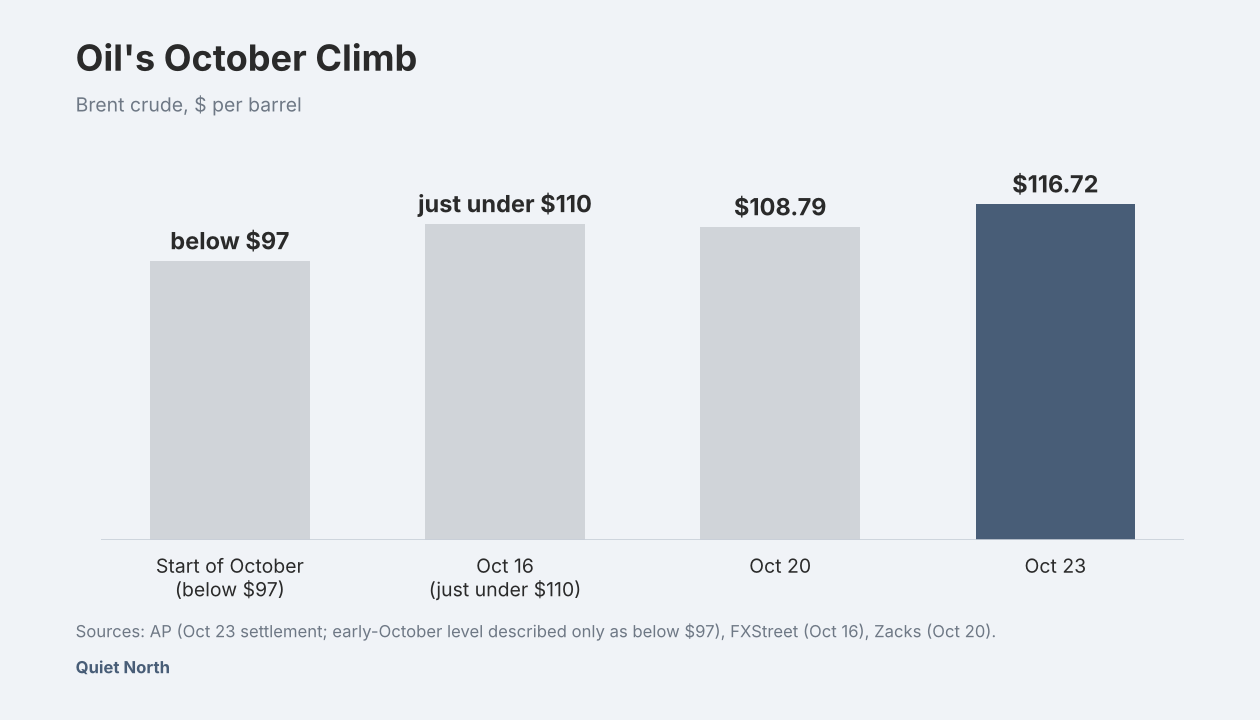
- Brent crude settled at $116.72 on Friday, October 23, the highest since June 2022, according to AP.
- The S&P 500 fell 0.5% for the week, closing at 7,623.68, while the Dow gained 0.4%.
- Consumer sentiment was 48.0 in the University of Michigan's final October reading.
- Gold opened near $4,012, its lowest level since July, according to Yahoo Finance.

Friday's close: oil weighed on stocks
The S&P 500 fell 0.5% on Friday, October 23, to 7,623.68, and the Dow fell 1.2% to 52,215.16. The Nasdaq Composite slipped 0.2% to 25,955.34, according to AP. For the week, the S&P 500 lost 0.5% and the Nasdaq lost 0.7%, while the Dow gained 0.4% and the Russell 2000 of smaller companies gained 2.0%, based on figures from La Nación.
Nearly three of every four S&P 500 stocks fell on Friday. Energy stocks rose, with Chevron up 2.9% and ConocoPhillips up 3.6%. AP attributed the decline to higher oil prices, along with worries about AI spending and high interest rates.
Oil and the pump: a lag worth watching
Brent rose 3.1% on Friday to settle at $116.72 a barrel, according to AP. It started October below $97. AP linked the surge to the war with Iran, which it says has severely cut the world's oil supply. Brent eased about 0.9% this morning.
Gasoline prices have not yet followed crude higher. AAA's national average was $4.27 a gallon in an article dated October 23, down from $4.33 a week earlier and $4.48 a month earlier, but up from $3.07 a year ago. AAA also said October is poised to be the most expensive October on record. Pump prices tend to lag crude, so the next few weeks matter, and energy costs remain the main driver of cost-of-living pressure.
Fed week: what to expect and when
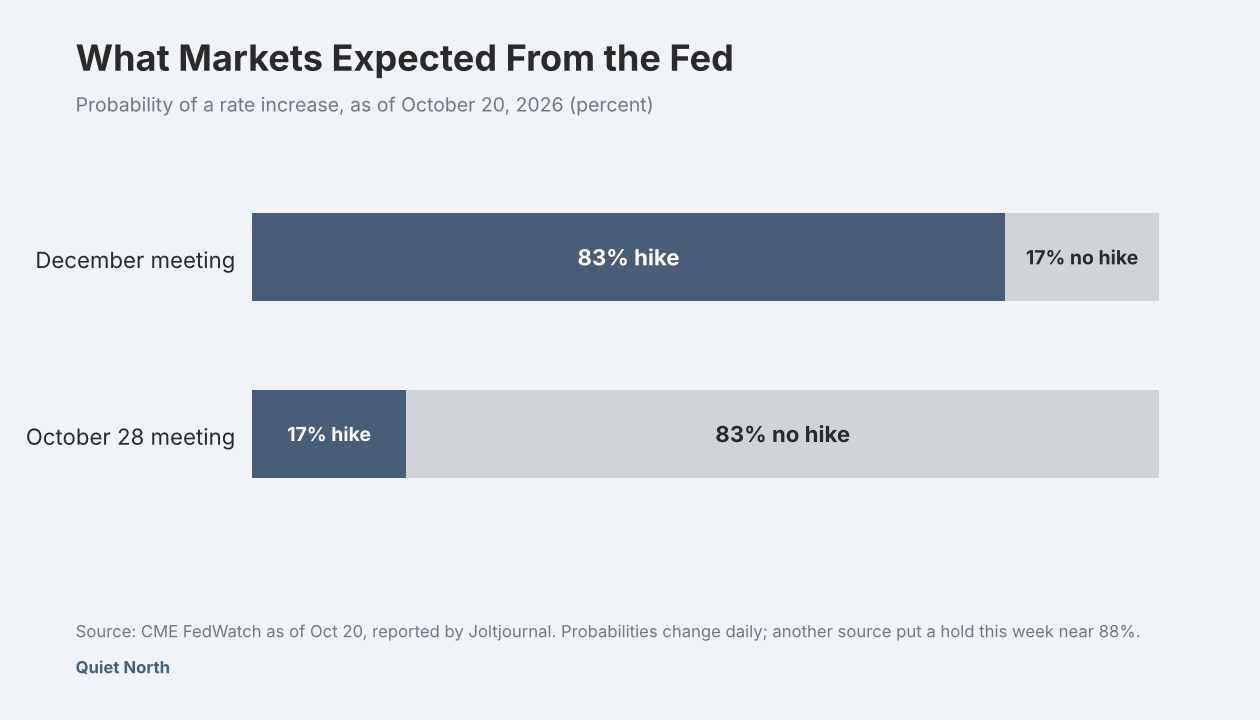
The Fed's target range is 3.75% to 4.00%, after a quarter-point increase on September 16 that passed 12 to 0. All 100 economists in the Reuters poll, run October 16 to 20, expect another increase in December. CME FedWatch put the chance of a December increase at about 83% as of October 20, according to Joltjournal. Another source put the chance of no change this week at about 88%.
Chair Kevin Warsh holds a press conference after the decision, and no new economic projections are due at this meeting. The week's other key events:
- Tuesday, October 27: consumer confidence, durable goods orders, and earnings from Coca-Cola, Boeing and Visa.
- Wednesday, October 28: the Fed decision, plus earnings from Microsoft and Alphabet after the close.
- Thursday, October 29: third-quarter GDP, expected near 3%, and September inflation by the Fed's preferred gauge, with core expected up 0.3%. Amazon and Intel report after the close.
- Friday, October 30: Exxon Mobil and Chevron report before the open.
Those dates come from HeyGoTrade's weekly outlook, which gave weekdays rather than dates.
Mood and metals
The University of Michigan's final October consumer sentiment reading was 48.0, above the 46.3 expected, according to investingLive, though Bloomberg described it as a five-month low. One-year inflation expectations were 4.7% and longer-run expectations were 3.5%, both unchanged. Sentiment is a survey of households, not a measure of spending.
Gold opened at about $4,012 an ounce this morning, its lowest level since July, and traded near $4,028 by 7:05 a.m. Eastern, according to Yahoo Finance via BizToc. Gold's role as a hedge against inflation has not been visible in recent weeks.
For Social Security recipients
The last regular October Social Security payment arrives Wednesday, October 28, for beneficiaries with birthdays from the 21st to the 31st, according to Fox. That is the same day as the Fed decision. Medicare open enrollment continues through December 7.
Higher rates also have a side effect for savers. Interest counts as income, and according to The Seattle Times on October 25, it can affect how much of a Social Security benefit is taxed and, two years later, Medicare premiums.
🔍 What This Means For You
- A decision day is also a signal day. The Fed is expected to hold on October 28, but its wording on December matters.
- Oil has moved first, and prices at the pump may follow. Brent is up more than 20% since the start of October.
- A weekly average can hide spread. The Dow and Russell 2000 rose last week while the S&P 500 and Nasdaq fell.
- Sentiment is weak even though stocks are still up for the year. The 48.0 reading is a five-month low, according to Bloomberg.
- Several headline numbers arrive this week. Fed policy, GDP and inflation data come within two days of each other.
❓ Today's question
"If the Fed holds rates on Wednesday, why are markets talking about a hike?"
Markets look ahead, so they price in what the Fed may do at later meetings, not only the next one. Futures put the chance of a December increase near 83%, while a hold this week is widely expected. The Fed's September minutes said most officials saw another increase as likely appropriate by year end. The Fed's statement and Chair Warsh's press conference are where those signals may become clearer. A hold means no change that day, and it is not a promise about December.

A busy week can feel like a lot to track. The useful habit is to separate what is scheduled from what is only expected, and what is expected from what is known.
By Friday, most of these numbers will be settled. Until then, patience is a reasonable posture for anyone who has watched markets for a few decades. 🔔
Regards,
David Ellison
Found this information useful?