
What Treasuries and dividend stocks each pay right now


🔵 U.S. markets are open today, Wednesday, October 21. Stocks finished Tuesday mostly higher, but the gains were uneven, and the sectors that pay the most dividends were among the weakest.
The most useful numbers this week are about income and housing. Treasury yields are above 5% at the long end, the typical stock pays about 1%, and contracts to buy existing homes fell to a record low in September.
Here is a briefing on what moved, what it shows about income, and what is still developing.
Key points
- The Dow rose 1.0% on Tuesday, October 20, while the Nasdaq was flat. The Russell 2000 gained 1.7%.
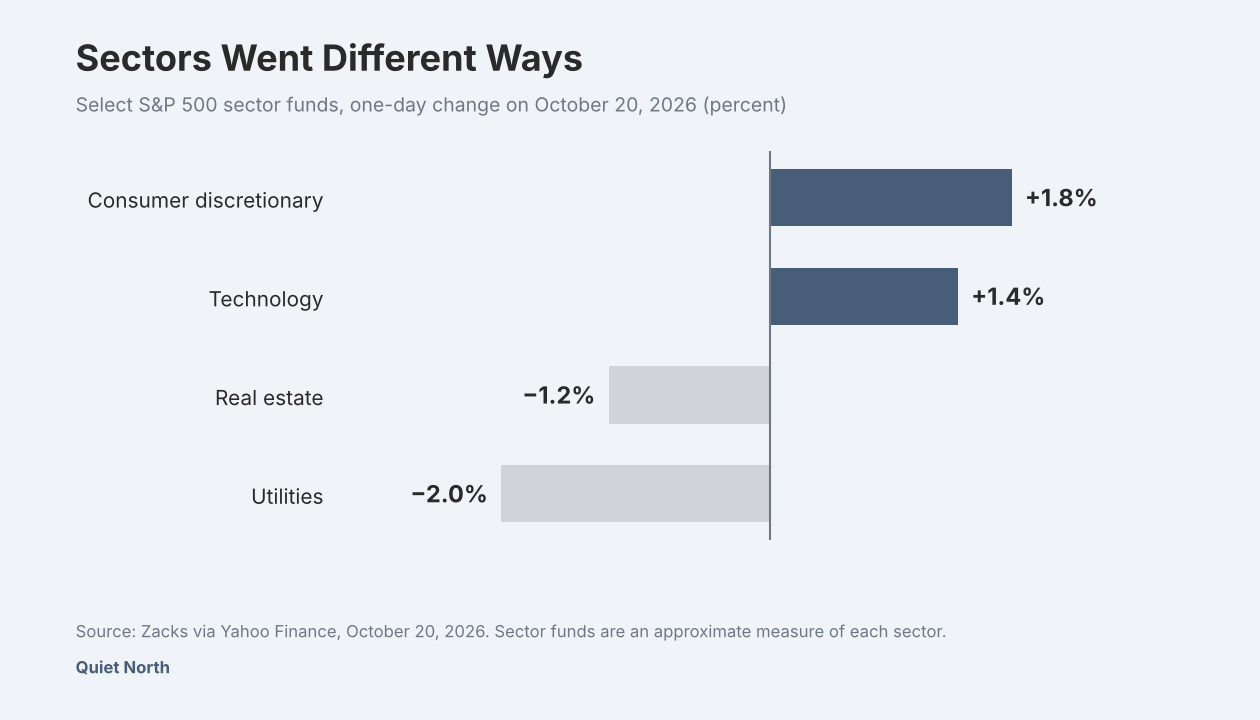
- Utilities fell about 2% and real estate fell about 1.2%, two sectors known for dividends.
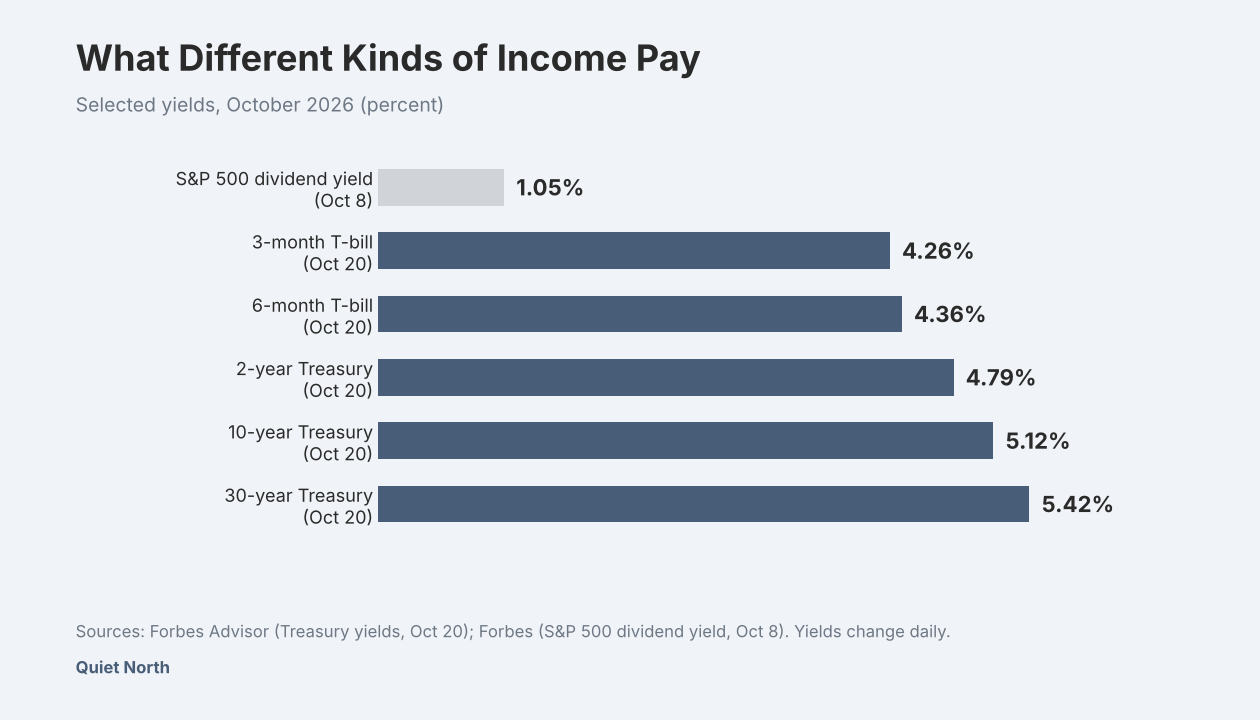
- The 10-year Treasury yield was 5.12%, and the 3-month T-bill was 4.26%, according to Forbes Advisor.
- Pending home sales fell 7.3% in September, to the lowest level since the index began in 2001.
- Tesla and Meta report after the close today.

Stocks rose, but leadership shifted away from tech
According to The Associated Press, the S&P 500 rose 0.3% to 7,712.57 and the Dow rose 1.0% to 52,495.88. The Nasdaq Composite slipped less than 0.1% to 26,424.82, and the Russell 2000 of smaller companies rose 1.7% to 2,773.42. For the year, the Dow is up 9.2%, the S&P 500 12.7%, the Nasdaq 13.7% and the Russell 2000 11.7%.
Only three of the 11 S&P 500 sectors finished higher, according to Zacks. Consumer discretionary rose 1.8% and technology rose 1.4%, while utilities fell 2% and real estate fell 1.2%. Sector funds are an imperfect measure, but the split shows how differently parts of the market behave on the same day. Oil fell, with WTI settling at $101.79 and Brent at $108.79, and the volatility index fell to 17.31.
What different kinds of income pay
The Treasury market now offers a range of yields. On October 20, according to Forbes Advisor, the 3-month T-bill yielded 4.26%, the 6-month 4.36%, the 2-year 4.79%, the 10-year 5.12% and the 30-year 5.42%.
Dividends look different. Forbes reported on October 8 that the S&P 500's dividend yield was about 1.05%, the lowest on record, largely because large technology companies pay little or nothing. Utilities and real estate companies pay more than the index, which is why many income investors hold them, but they also borrow heavily, and rate-sensitive stocks tend to feel higher yields most.
The comparison to keep in mind:
- Treasuries pay a fixed yield and return principal at maturity if held.
- Dividend stocks pay an amount the company chooses, and the share price can move.
- The index yield is low partly because many companies pay no dividend.
Housing: contracts fall to a record low
The National Association of Realtors reported on October 20 that its pending home sales index fell 7.3% in September to 66, down 11.3% from a year earlier. Bloomberg reported it was the lowest since the index began in 2001, and the drop was steeper than any economist forecast. Every region declined, with the West down 9.2% and the South down 8.2%.
NAR chief economist Lawrence Yun said conditions "weakened in September due to fast-rising mortgage rates," and added that buyers and sellers "may simply be holding back until mortgage rates move favorably." Freddie Mac's most recent 30-year average was 7.40% on October 15.
New construction was soft too. Housing starts fell to 1.221 million in September, below the 1.308 million economists expected, according to Zacks. Lower activity can mean slower price growth and fewer moves, which matters to homeowners thinking about downsizing.
Tech, AI and oil: what to watch today
Technology news was busy. SpaceX reported third-quarter results on Tuesday that beat analyst estimates, according to Bloomberg and Yahoo Finance, and CNBC reported that Musk said Tesla and SpaceX had formed special committees to discuss a possible merger. No deal has been announced, and the story is still developing.
Netflix said revenue rose 12% to $12.9 billion, but guided to slower growth and lower profit for the fourth quarter, and its shares fell about 5% after hours, according to The Motley Fool.
Today's calendar:
- 10:30 a.m. Eastern: weekly U.S. crude inventories from the Energy Information Administration.
- 1:00 p.m. Eastern: Treasury's 20-year bond auction, a read on demand for long-term debt.
- After the close: Tesla and Meta report, along with IBM and Texas Instruments, according to TheStreet.
- October 27 and 28: the Federal Reserve meets.
🔍 What This Means For You
- Income comes in different forms. Treasuries yield 4.26% to 5.42%, while the S&P 500 yields about 1%.
- Dividend sectors are sensitive to rates. Utilities fell 2% and real estate fell 1.2% on October 20.
- A flat index can hide big moves. The Nasdaq was flat while the Dow rose 1.0% and the Russell 2000 rose 1.7%.
- Housing is slowing. Pending home sales are at a record low, and mortgage rates are near 7.40%.
- Tech news is still moving. Earnings from Tesla and Meta arrive tonight, and the SpaceX merger talk is unconfirmed.
❓ Today's question
"Why can a dividend stock's price fall when its dividend has not changed?"
A share price reflects what investors will pay for a company's future income, and that depends partly on what safer options pay. When Treasury yields rise, investors can ask for a higher yield from a stock, which means a lower price for the same dividend. Utilities and real estate companies also borrow heavily, so higher rates can raise their costs. The dividend itself is set by the company's board, and a stock's yield rises when its price falls, even though the payment is unchanged. That is why a high yield can sometimes signal stress, and sometimes only a lower price.

A quiet index can hide a busy day underneath. Dividends, bond yields and housing all respond to the same interest rates, but at different speeds and in different ways.
Reading the numbers side by side is a steadier habit than reading any one headline. Most of what moved this week is measurable, and what is still unknown is worth stating plainly.🔔
Regards,
David Ellison
Found this information useful?